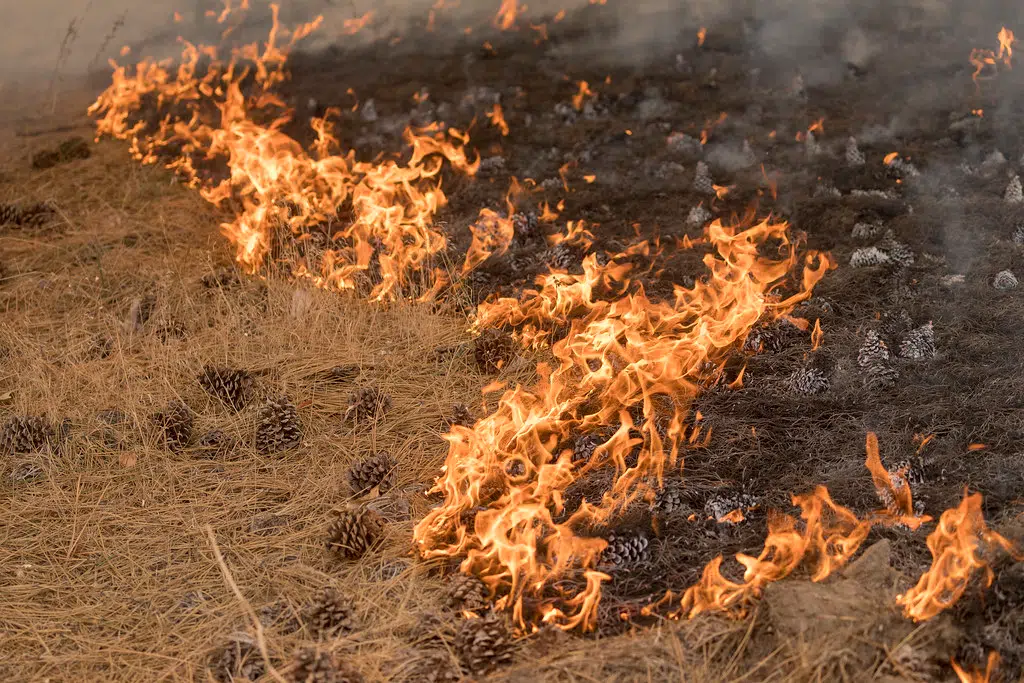
KEARNEY — With the return of unseasonably warm temperatures, elevated to near-critical fire weather conditions will also be in place today.
According to the National Weather Service – Hastings, the near critical fire weather conditions will be starting this afternoon for areas mainly along and south of a line from Arapaho to Mankato, Kan.
Relative humidity levels will fall to 20 to 25 percent and southerly wind gusts at 25 to 30 mph are expected. High temperatures will reach the mid to upper 90s in this area.
Elevated to near critical fire weather conditions are likely to continue Friday and into the weekend for much of the outlook area.
“While relative humidity is currently forecast to remain above the traditional thresholds of 20 to 25 percent, the combination of hot temperatures and strong southerly winds gusting to 30 MPH, and at times, as high as 40 mph,” per NWS Hastings.
All this could result in dangerous fire weather conditions, especially considering ongoing severe to exceptional drought conditions.
The pocket of exceptional drought, D4, conditions in central to eastern Nebraska expanded from 1.3 percent to 4.7 percent this week.
The D4 conditions crept into the eastern portions of Hall County and northeastern area of Adams County. Buffalo County remains separated down the middle between severe drought in the east and moderate drought in the west.
“Half an inch to locally 2 inches of rain fell over western and southern parts of the High Plains region, mostly in Colorado, southern Kansas, and parts of Nebraska,” per the U.S Drought Monitor, “But most of Wyoming, the Dakotas, Nebraska, and Kansas were dry this week.”
“The compounded effects of excessive summer heat and overall dryness over the last one to two years resulted in expansion of D3 and D4 in parts of southeast Nebraska,” the Drought Monitor stated.
“Sporadic summer showers have not had much of an impact on the multi-year drought, with low soil moisture continuing and stressed vegetation as seen on satellite-based indicators,” per the Drought Monitor.
“A farmer/rancher in Nuckolls County reported stock ponds had never gone dry in his 65 years living in the county until this summer and his crops were all burned up,” the Drought Monitor stated.