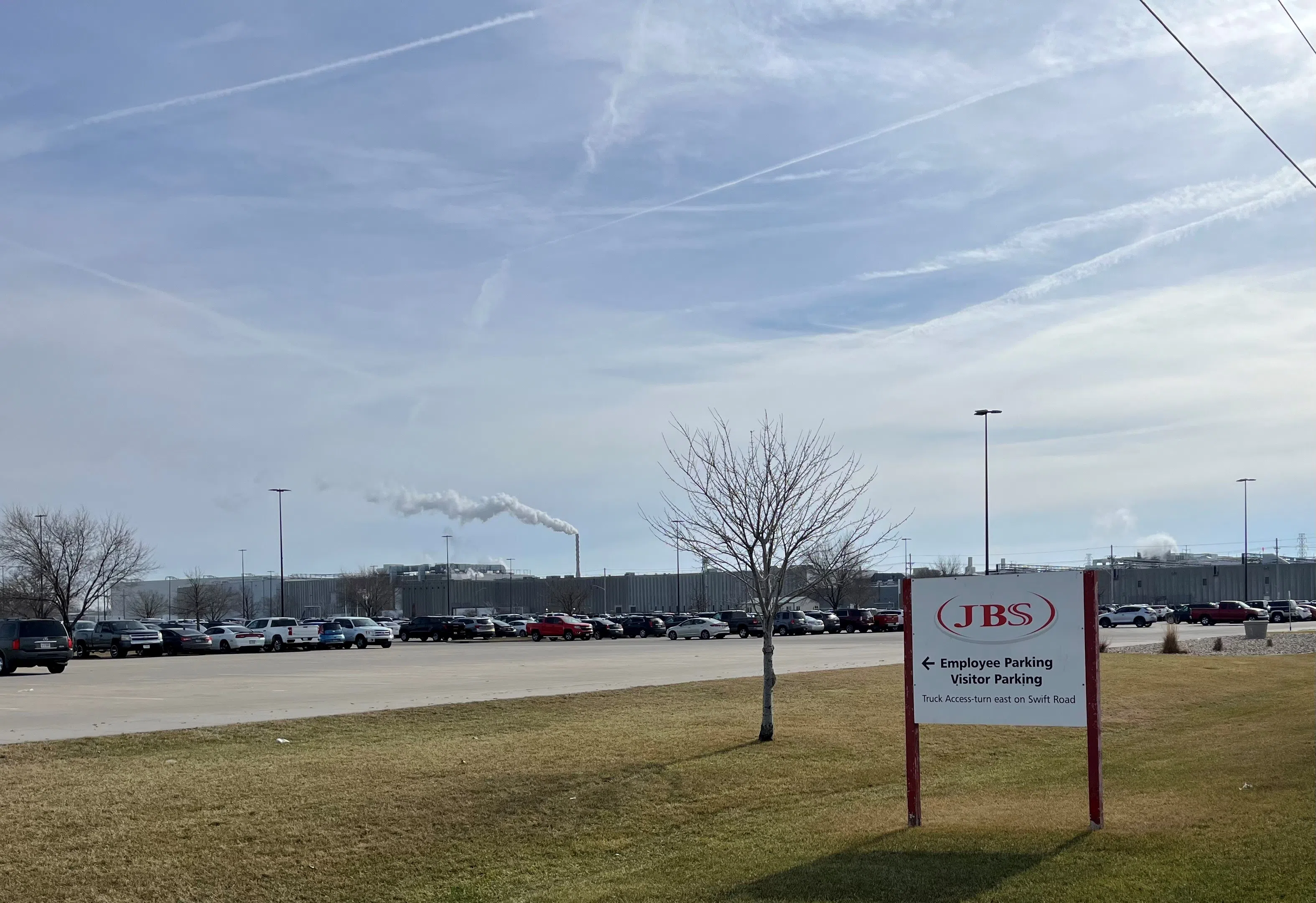
There was a large sewage lagoon breach at the JBS plant east of Grand Island on Jan. 6. (Carol Bryant, Central Nebraska Today)
GRAND ISLAND — Prior to the Jan. 6 wastewater lagoon breach at JBS, JBS had received a Nov. 9, 2023, letter from the EPA to address JBS’s “violations of their National Pollutant Discharge Elimination System permit for discharges of process wastewater.”
JBS responded to the EPA and also the Nebraska Department of Environment and Energy regarding statement 32 in the Nov. 9 letter about sending to the EPA “a comprehensive written plan for maintaining ongoing compliance with the effluent limitations contained in Respondent’s Permit.”
JBS “has committed to obtaining a third-party review of wastewater treatment operations on a quarterly basis for the following two years,” according to a Feb. 15 letter from JBS Plant General Manager Tony Lang to the Nebraska Department of Environment and Energy.
Regarding the north lagoon, JBS will “rebuild the breached lagoon and piping system to better than original construction.”
JBS has hired HDR Engineering “to visit the site and investigate the wastewater treatment operations. HDR is a recognized leader in wastewater treatment operations of our industry,” the Feb. 7 letter said.
In the Nov. 9, 2023, letter from the EPA, it says that the EPA and JBS are entering an agreement “to restore and maintain the chemical, physical, and biological integrity of the Nation’s waters.” The letter said that JBS has the capacity to process up to 6,500 cattle per day. The facility includes a “kill plant, processing area, packaging and storage areas, rendering plant, and pretreatment system.” JBS “employs approximately 3,600 employees at the facility, which is run 24 hours a day for 6 days a week.”
JBS discharges process wastewater through two outfalls: “Outfall 1 discharges to the Grand Island Utilities Ditch; Outfall 2 discharges to the city of Grand Island Wastewater Treatment Facility. (WWTF). The Grand Island WWTF discharges into the Wood River.”
Based on sampling performed and data collected by JBS, JBS violated either the daily maximum or monthly average effluent limitations on the following months:
- a. Biochemical Oxygen Demand: June 2020 and February and October 2021;
- b. Chloride: July, August, September, October, and November 2019, January 2020, September 2022, January and February 2023.
- c. Ammonia: September and December 2019 and January 2021;
- d. Total Kjeldahl Nitrogen: June 2013, October 2018, December 2019, June, July August September 2020, February and October 2021; September 2022, and November 2022.
- e. Total Suspended Solids: June, July, August, September, Octobre, and December 2018, January 2019, January, February, March, June, July, August, September, October, and November 2020, January February, May, October, November 2021, June, September 2022, and March 2023.
The Feb. 7, 2024, letter from JBS contains an attached plan dated Feb. 5 and titled “Study and Report: Biological Wastewater Treatment System.”
The Feb. 5 report said that approximately 5,000 head per day of cattle are processed five-six days/week at JBS.
‘HDR visited the JBS Grand Island facility on October 2023 to meet with plant staff and collect site data to support this evaluation. Wastewater from the beef processing facilities is directed to Lagoon No. 2. Wastewater flows by gravity from Lagoon No. 2 to No. 1. Lagoon
No. 1 (the lagoon that was breached) has a capacity of 7 million gallons. Lagoon No. 2 has a capacity of 25 million gallons.
The Feb. 7 letter said the east edge of Lagoon No. 1 berm failed on Jan. 6.
“Onsite personnel indicated that the berm release occurred about 2-3 hours after seepage was observed in the area of the effluent manhole. The lagoon berm failure appears to have occurred due to a failed manhole.”
The Feb. 7 letter said that two alternatives can be considered:
*Make lagoon repairs that meet the original lagoon’s design conditions. That will include: remove accumulated sludge remaining in lagoon. Place earth berm fill recommended soil compaction and berm stability; repair lagoon bentonite linter along lagoon bottom and interior side slope; replace 100-mil HDPE cover and weld to existing lagoon cover; replace manhole and piping connections; replace transition manhole between Lagoons No. 2 and No. 1.
- *Make lagoon repairs and improvements that incorporate upgraded designs. This includes: remove accumulated sludge remaining in the lagoon; place earth berm fill meeting recommended soil compaction and berm stability; remove existing HDPE cover and bentonite liner systems; install a new dual HDPE liner system with leak detection and under-liner gas venting; install a new HDPE cover system with cover weight pipes for storm water collection and biogas collection to existing systems; replace effluent manhole and piping connections; incorporate corrosion resistant manhole materials; replace transition manhole between Lagoons No. 2 and No. 1.
The report noted that the second alternative “will provide an updated lagoon liner system and be consistent with today’s current best practice design.” The report gives a timeline that begins Feb. 12 and ends Sept. 27 for accomplishing the improvements.
A Jan. 18 letter from the Nebraska Department of Environment and Energy (NDEE) to JBS Plant Manager Tony Lang is titled “Letter of Noncompliance.” The letter says that NDEE documented the following:
- *”Unlawful discharge of water pollutants to waters of the state. MBS discharged an estimated 2 million gallons of process wastewater and sludge to Wood River and an unnamed tributary on Jan. 6, 2024, containing water pollutants such as ammonia, nitrogen, chloride, oil/grease, and organic matter as measured by biochemical oxygen demand.”
- *”Discharging without authorization. The facility discharged an estimated 2 million gallons of process wastewater and sludge from the wastewater treatment system to waters of the state as a result of the north lagoon failure in a manner not authorized” under various regulations or permits.
- *”Failure to comply with wastewater treatment facility operation and maintenance requirements. Embankment failure on the east dike of the north lagoon caused discharge of process wastewater and sludge to waters of the state. Soil erosion was observed at several locations along the north and south lagoons, creating a risk of future lagoon failures.’
- *Failure to comply with reporting requirements.
- *”Violations of aesthetic water quality standards. Wastewater and sludge were discharged into the unnamed tributary of Wood River and Wood River resulting in the change of the color, turbidity, and deposition of sludge in waters of the state.”
- *”Violations of aquatic water life quality standards. Wastewater and sludge were discharged into the unnamed tributary of Wood River and Wood River resulting in a fish kill event.”
- *”Failure to meet conditions of a general permit. The facility has not removed discharged solids from the lagoon release from the adjacent street resulting in further trackout along the public street.
The letter gives JBS until Feb. 15 to do numerous things, including:
- *Provide a written plan to assess and remediate off-site contamination from adjacent properties and waters of the state that was discharged during the Jan. 6 release.
- *Provide a stream sampling plan to monitor water quality in the Wood River.
- *Provide documentation demonstrating that JBS has contracted with a third party to conduct an engineering evaluation of the current operational condition of the facility’s wastewater treatment system and a schedule of when the engineering evaluation will be complete.
- *Provide documentation on the facility plan to temporarily repair the existing erosion observed on the lagoon dikes.
- *Submit reports detailing cleanup of the facility parking lots and roads.
“The Department requests that you voluntarily comply with these corrective measures,” the Jan. 18 letter said. “Enforcement action may include issuance of an administrative order, or referral to the Attorney General for civil or criminal penalties of up to $10,000 per day per violation.”