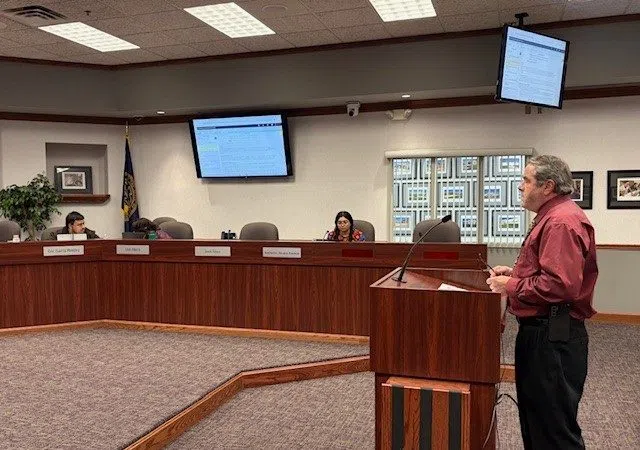
Kearney Public Library, (Brian Neben, Central Nebraska Today)
KEARNEY — There will be a meeting this evening to discuss Accessory Dwelling Units at the Kearney Public Library from 6-7 p.m.
The City of Kearney is hosting the meeting to inform the community about Accessory Dwelling Units (ADUs), hear feedback from residents and allow questions to be asked.
The meeting is open to the public and will be held at the Kearney Public Library in the Niobrara Room.
Residents can attend either in person or via Zoom.
- Zoom Meeting Link
- Meeting ID: 811 3822 4631
- Passcode: 153751
The Kearney Planning Commission has been discussing ADUs at their earlier meetings this year.
Melissa Dougherty-O’Hara, Assistant Development Services Director and Melia Smith, Associate Planner, both presented information about ADUs during the commission’s February meeting.
It was noted that Kearney does not allow for ADUs in the community at this time.
Smith said an ADU is a small residence that is located on the same lot as a single-family home or a primary dwelling. As an independent living space an ADU is self-contained with its own kitchen or kitchenette, bathroom and sleeping area.
An ADU’s use is incidental to and customarily associated with specific principal use or building on the same site.
An ADU can be located within, attached to, or detached from the main residence and can be converted from an existing structure, like a garage or built new.
At the close of February meeting, the commission expressed interest in ADUs, to communicate with the Kearney City Council and to discuss if further.
Dougherty-O’Hara said that there were a few ways forward, including forming a sub-committee to provide a report on ADUs and then to submit this to the city council.
However, since this will involve a code change, this will require thoughtful planning and public outreach to gauge the community’s interest in ADUs, Dougherty-O’Hara said, which will take place in the future.
Accessory Dwelling Units
There are several types of ADUs, Smith said, one of which is a detached ADU, a stand-alone home on the same lot as a larger, primary dwelling. Examples include a backyard bungalow or converted outbuilding.
An attached ADU connects to an existing house, typically through the construction of an addition along the home’s side or rear. Such units can have a separate or shared entrance, Smith said.
There can also be interior ADUs, upper and lower levels.
Access to an upper level ADU can be provided through a stairway inside the main home or directly from an exterior staircase, said Smith.
A lower level ADU is typically created through the conversion of a home’s existing basement, if height and safety conditions are met, during construction of the house or as a part of a foundation replacement and house lift, Smith said.
There are also garage conversions, Smith said, a garage ADU converts all or part of an attached or detached garage into a residence. An ADU can also be added above a garage or building a new unit for both vehicles and people.
Dougherty-O’Hara said several peer communities throughout Nebraska already have allowances for ADUs. Those include, North Platte, Grand Island, Hastings, Lincoln, Omaha, Fremont, Papillon, Bellevue and Norfolk.
Grand Island is the only community that allows attached ADUs. Five out of the ten communities require additional parking for ADUs, and the majority require a conditional use or special use permit.
All but two communities have design standards for ADUs, Dougherty-O’Hara said, these include height restrictions, roof pitch and design materials.
Only three of the ten communities have size restrictions for ADUs, which range from 750 square feet to 960 square feet.
Looking at the pros and cons of ADUs, Dougherty-O’Hara said on the positive side, they can help increase housing options and inventory. They can be more affordable and allow for multi-generational living or aging in place for seniors.
Well designed and property maintained ADUs can also help increase property values.
On the other side of the issue, ADUs can lead to increased traffic and more crowded parking. They can also strain public services or existing infrastructure in the area.
Dougherty-O’Hara said they can increase density or overcrowding and could impact the existing neighborhood character. She added that if ADUs are not well regulated or not property maintained, it can have a negative effect on property values.