GRAND ISLAND – More than 700 fifth-grade students representing 36 school groups and 17 counties participated in the 36th annual Nebraska Children’s Groundwater Festival Tuesday, May 14.
The event occurred at the Central Community College and College Park campuses in Grand Island from 8:45 a.m. to 3:30 p.m. May 14. The Central Platte Natural Resources District (CPNRD) hosts the event.
A purpose of the event is to have students participate in classroom-style activities focused on groundwater and its significance to Nebraska.
Students had the opportunity to interact with professionals from 36 water and natural resources organizations.
Marcia Lee is information and education specialist with CPNRD.

Marcia Lee is an information and education specialist with the Central Platte Natural Resources District, (Carol Bryant, Central Nebraska Today)
“We feel it’s important for our youth,” Lee said. “How fortunate we are to have the natural resources we do have. It is important for all of us as individuals to take care of those natural resources.”
CPNRD has coordinated the festival since 2004, marking this year as the 20th anniversary of CPNRD’s involvement in the event. The Nebraska Children’s Groundwater Festival was the first of its kind, and has led to similar festivals being established in nearly 40 states, as well as in Mexico, Canada, India, and the United Kingdom.
Students participate in six 25-minute sessions that engage their critical thinking and problem-solving skills. They also attend two stage shows. There were 34 classroom-style activities. The festival covers a wide range of topics related to groundwater, including aquifers, floodplains, watersheds, stream health, wildlife, ecosystems, wetlands, stormwater, wastewater, groundwater for agriculture, soil health, and other topics.
In the Green/Gray Relay class, students used a relay game to study the difference between water that goes through green items such as grass before passing into the ground versus water that hits gray items such as concrete and then runs off unfiltered into the ground.
Lee said with green infrastructure, items such as grass and trees help filter contaminants out of our groundwater. With gray infrastructure such as concrete, water is not allowed to be cleaned through the natural process.
At the Raptor Connection stage show, a staff person with the Raptor Conservation Alliance had a live great horned owl to show to students. It is the largest owl found in Nebraska. The Alliance was founded in 1976 and works with 300 to 600 birds a year that are sick, injured, orphaned or have other conditions.

A staff member with the Raptor Conservation Alliance shows students a great horned owl at the Nebraska Children’s Groundwater Festival, (Carol Bryant, Central Nebraska Today)
In the Incredible Journey class, students “became” water molecules and moved through the water cycle by collecting beads along the journey to make a bracelet.
Olivia Esser, 11, from Sandy Creek School said that she liked to look at the different water processes.
Paxton Janzen, 11, from Sandy Creek School said he enjoyed learning about the cycle of water.
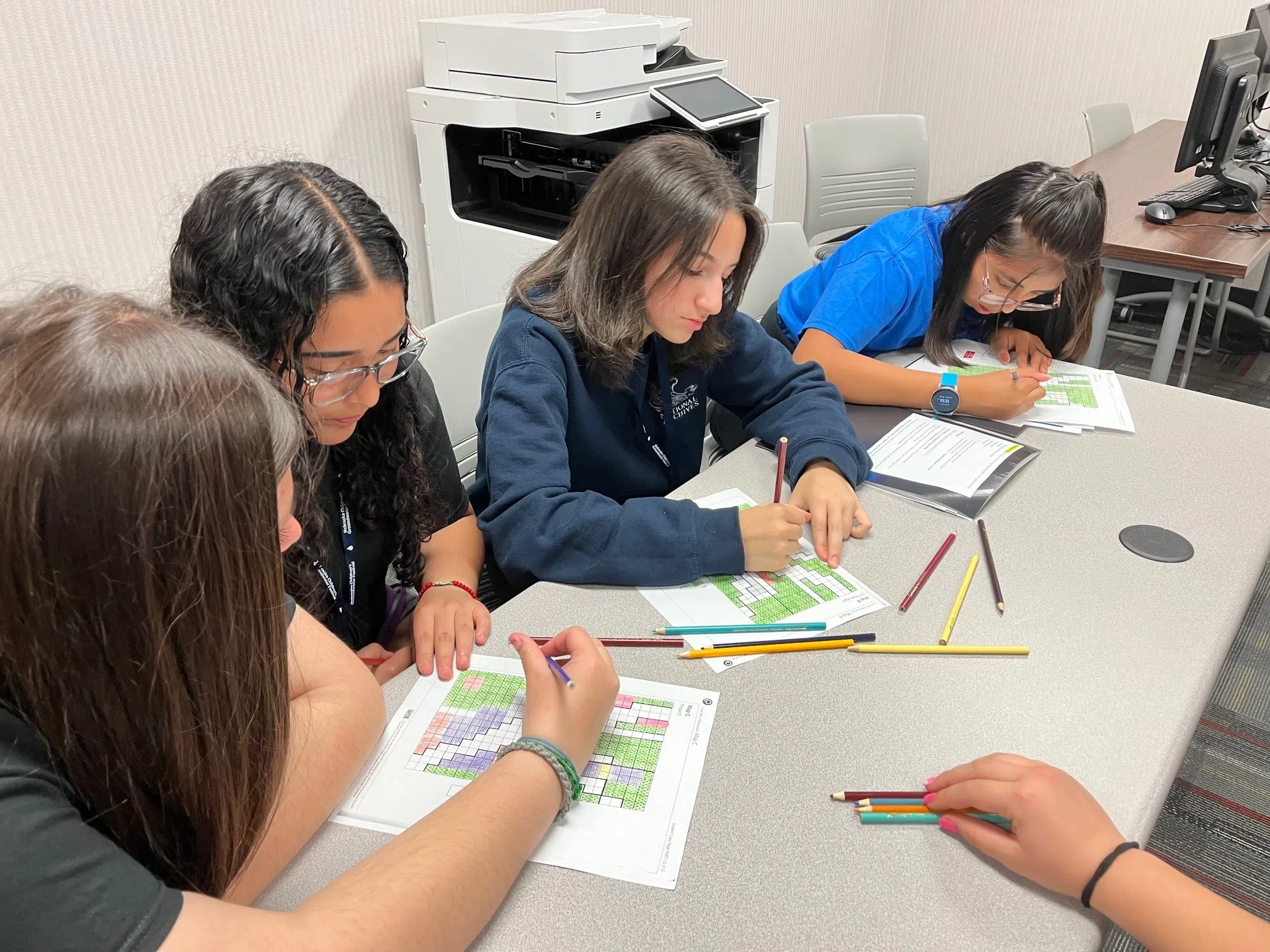
In the Color Me a Watershed session, students received three maps showing water flow in the Wood River 100 years ago, 50 years ago, and now. Staff members from CPNRD and the Nebraska Forest Service showed students how to interpret the maps to determine how development can affect a watershed. Students used colored pencils with colors representing specific items on their maps.
The large event would not be possible without the sponsorship and participation from numerous organizations, Lee said. CPNRD is the main sponsor and contributes $10,000. The cost to have the event is $14,000 to $15,000. More than 100 volunteers assist with various tasks, ranging from guiding school groups to manning registration desks. Fifty National Junior Honor Society students from Barr Middle School in Grand Island helped as classroom guides and assistants.
“We have a lot of local, state and national partners,” Lee said. “We’re very appreciative of that,” Lee said.
Central Community College and College Park donate use of their buildings for the event. A large tent was set up in between Central Community College and College Park and served as the lunchroom for the event. Students received a free lunch.