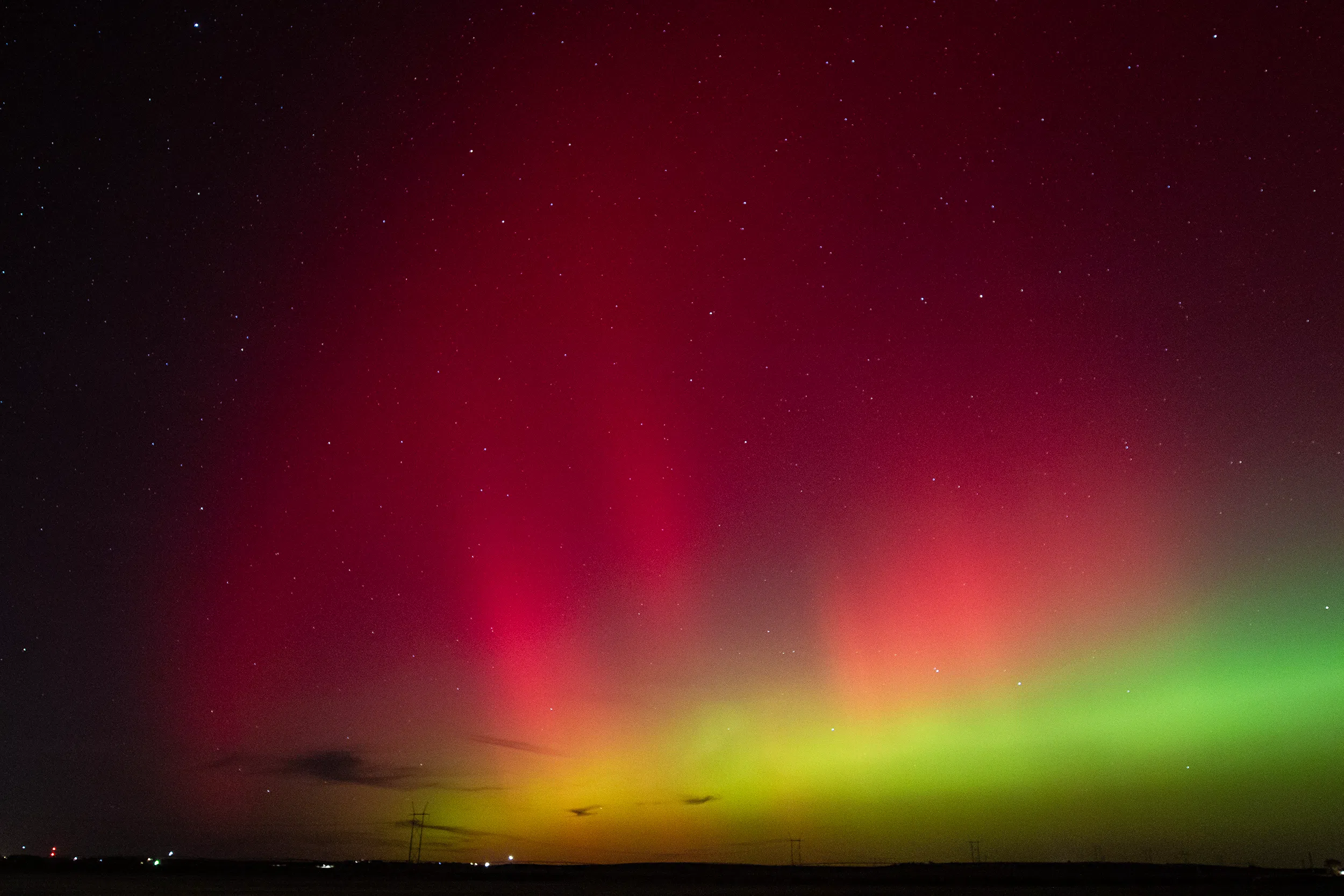
Auroras visible in central Nebraska during the evening of Tuesday, Nov. 11, (Brian Neben, Courtesy)
KEARNEY — Auroras were highly visible across central Nebraska during the evening of Tuesday, Nov. 11. A strong geomagnetic storm is ongoing, and auroras could be visible to the naked eye tonight.
According to the Space Weather Prediction Center, geomagnetic storm conditions are currently at G3 (Strong) levels after peaking to G4 (Severe) yesterday.
“The nature of the current disturbance means that G4 conditions, which a chance for higher levels, are still possible. The threat is expected to remain throughout the day as another disturbance is expected to arrive around midday on (Nov. 12),” per the SWPC.
The SWPC noted that auroras were visible over much of the country during the evening of Nov. 11. Elevated geomagnetic storm levels are likely to carry over to Nov. 14.
These types of geomagnetic storms occur when coronal mass ejections from the Sun reach Earth.
“Coronal Mass Ejections, (CMEs) are explosions of plasma and magnetic fields from the sun’s corona. They cause geomagnetic storms when they are directed at Earth. Geomagnetic storms can impact infrastructure in near-Earth orbit and on Earth’s surface, potentially disrupting communications, the electric power grid, navigation, radio and satellite operations,” NOAA Space Weather Prediction Center stated.
The sun’s activity fluctuates on an 11-year solar cycle, with periods of peak activity known as solar maxima.
Auroras are caused by energized particles from the sun slamming into Earth’s upper atmosphere at speeds of up to 45 million mph.
“Green auroras are typically produced when charged particles collide with high concentrations of oxygen molecules in Earth’s atmosphere at altitudes of around 60 to 190 miles. People can see green auroras the best because the human eye is most sensitive to the green color spectrum,” according to Space.com.
“Red auroras are comparatively less frequent and are usually associated with intense solar activity.
They occur when solar particles react with oxygen at higher altitudes, generally around 180 to 250 miles,” per Space.com.
At this height, oxygen is less concentrated and is excited at a higher frequency or wavelength, making reds visible. Red auroras are often seen at the higher edges of the display.