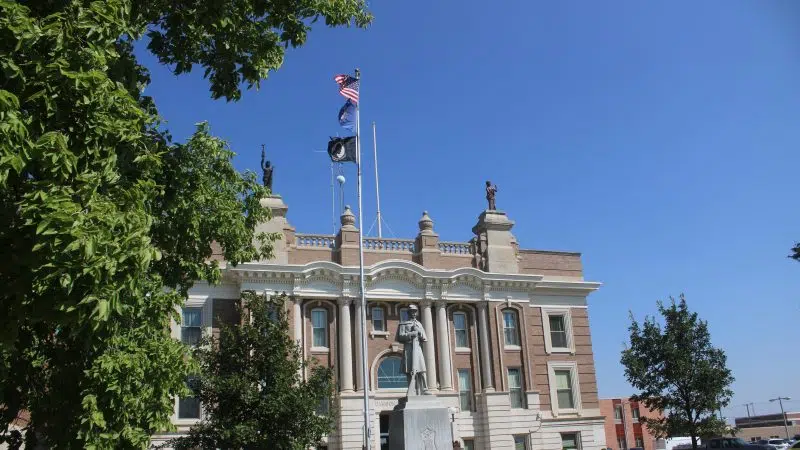
The Grand Island City Council has interest in getting an ice rink at the Heartland Events Center. (Courtesy)
GRAND ISLAND – Grand Island’s City Council voted 8-1 to have Mayor Roger Steele execute all necessary documents to apply for the Civic and Community Center Financing Fund (CCCFF) grant application for $1 million for an ice rink chiller at the Heartland Events Center.
The total cost of the ice rink chiller is an estimated $2.5 million, with the city being responsible for paying $1.5 million if the grant is received. City Council Member Maggie Mendoza was absent from the Jan. 13 meeting, and City Council Member Doug Lanfear voted against the motion.
Although the city will submit the letter of intent, a decision needs to be made at a later date whether the city has funds available for the ice rink chiller.
The ice rink could be used for everything from professional hockey to a location for community ice skating.
The Nebraska Department of Economic Development makes the CCCFF available.
The first step in submitting the grant application is to submit a letter of intent, which is due Jan. 15, according to a memo from City Administrator Pat Brown and Community Development Director Chad Nabity. The grant funds are supposed to support projects that promote economic opportunity and a higher quality of life.
The application is due Feb. 15 with a grant award date of March 30.
Application for the grant does not necessarily mean that the City Council will choose to fund the project in the FY2027 budget. Money from the hotel occupation tax, food and beverage funds; keno funds; or city general fund could be used.
City Council Member Chuck Haase said he supported submitting a letter of intent, noting that the grant would provide $1 million of the total $2.5 million project cost.
City Council Member Doug Lanfear wondered whether it was worth spending $1.5 million on the project.
“I don’t like this,” he said. He noted that the city would be paying for other improvements at Heartland Events Center.
City Council Member Mark Stelk said that he was in favor of submitting the letter of intent.
“I want to see the whole picture,” Stelk said. “There’s a lot of expense, and there’s a lot of risk.”
Brown said that there would be more discussion of the project at a Feb. 21 City Council budget retreat.
Kyler Tarwater, executive director of the Heartland Events Center, said that the return to the community for having an ice rink is “massive.” He said that the ice rink could be used for a variety of events.
In another matter, the City Council voted 9-0 to approve a five-year contract with the Grand Island Casino Resort for Grand Island police officers to work uniformed security. The item was pulled from the consent agenda for discussion by the City Council.
In a memo to the City Council, Police Chief Kevin Denney said that police officers had been periodically working overtime uniformed security at the Grand Island Casino Resort in 2025. A contract was developed to ensure that expectations are clear, reimbursements are governed by contract, and to codify liability and insurance obligations.
Denney wrote that the city and Grand Island Casino Resort had agreed to a five-year contract for periodic uniformed security by Grand Island police officers, at an overtime rate of pay. Police officers would work in addition to casino security officers.
Denney said at the meeting that work at the Grand Island Casino Resort is a good source of income for police officers. Police officers are visible at the casino, and their presence helps lower crime.
The police chief said that he thought that the work would primarily be on Fridays and Saturdays.
“We wouldn’t go understaffed in any shift,” Denney said.
City Council Member Doug Lanfear said he has a son who is a law enforcement officer who works additional hours for special security issues.
“It’s very beneficial,” Lanfear said.
City Council Member Chuck Haase asked if police officers were not stationed at the casino, would there be any other entity providing security.
Denney responded that probably wouldn’t occur.
Haase noted that $650,000 was budgeted for police overtime pay.
“One of the biggest things I don’t want to see is officer burnout,” Haase said.
Denney said that officers who would work at the Casino would be ones that were either working an 8-hour shift that day or not working. Normally two officers would be on duty.
Denney listed the number of police service calls for the Casino: 2022, 11 calls; 2023, 25 calls; 2024, 22 calls; 2025, 47 calls.
City Council Member Jack Sheard asked whether police officers were excited about this opportunity. Denney responded that they were.
In other action, the City Council voted 9-0 to dissolve an Inter-Jurisdictional Planning Commission (IPC) at the request of the Merrick County Board of Supervisors. The IPC has three representatives from Merrick County and three representatives from Hall County. It makes recommendations on all zoning actions or subdivisions that occur within Merrick County and the Grand Island extraterritorial zoning jurisdiction (ETC), wrote City Attorney Kari Fisk. The ETJ extends up to 2 miles from the Grand Island municipal limits.
The City Council voted 9-0 to approve selling city property adjacent to a residence located on Harrison Street between Brach’s Lake and the street for $2,000. The city does not use the property.
The City Council voted 9-0 to sell a tract of land bordering Ryder Park and John Baasch Auger Flighting to John Baasch Auger Flighting for $11,983. The property historically has been used as an alleyway or for storage by Baasch Auger, but no alley or roadway is platted. Baasch Auger will pay an estimated $60,000 to relocate electric lines. Baasch Auger has agreed to give the city a public utility easement over the property so long as public utilities remain on the property.
In the consent agenda, the City Council approved a contract for lobbyist services regarding Good Life District legislation for $3,000 a month, not to exceed $30,000. The Good Life Transformational Projects Act was passed in 2023 and amended in 2024. City Administrator Pat Brown wrote in a memo to City Council that the Legislature significantly changed the Good Life District law in its 2025 session, primarily through LB 707. Prior to LB 707, annual revenues in the Good Life District was approximately $7 million to $7.5 million. It is now capped at $5 million for existing businesses.
“Grand Island could still receive more revenue if and when new to market businesses open in the Good Life District,” Brown wrote. LB 707 now limits tax breaks to retail and entertainment businesses, excluding others.
City administration recommended retaining Jensen Rogert Associates to help protect the Good Life District in Grand Island. The city solicited professional services from two lobbying firms without conflicts of interest, and one declined representation due to existing client workload. Brown wrote that waiting 15 to 30 days for quotes would be detrimental to city interests.