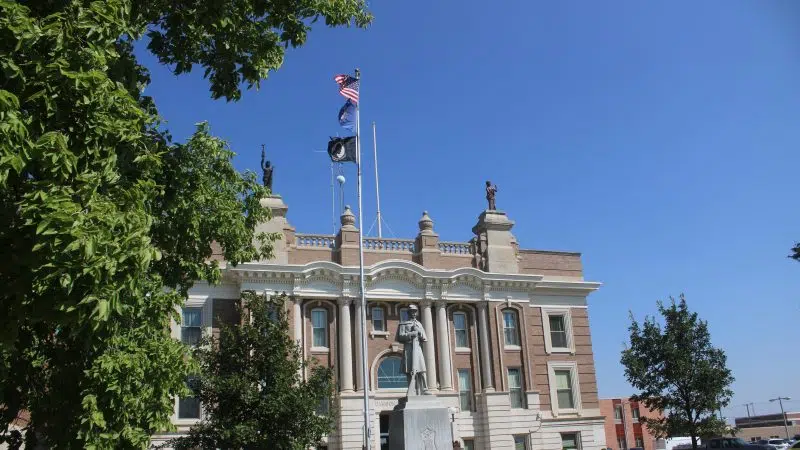
Grand Island Mayor Roger Steele is recommending acquiring a bookmobile to supplement Grand Island Public Library services. (Carol Bryant, Central Nebraska Today)
GRAND ISLAND – Grand Island Mayor Roger Steele is proposing that the city needs a bookmobile so that more people have access to a library and its services.
Steele said at the State of the City address on Jan. 12 that children cannot drive, some people have limited access to transportation, that particularly children will not be able to go to the library at 1124 W. Second St.
Steele said he had asked Library Director Celine Swan whether a bookmobile or a branch location of the library would be better. Swan responded that a bookmobile would be better, because it would provide access to more parts of the city.
The mayor said that Gov. Jim Pillen is concerned that Nebraska has a “brain drain.”
Steele said that efforts are not being made to make Nebraska “attractive to children and families.” So those families are going elsewhere. He said it’s important to have children get off to a good start, and that’s an investment in the future.
“That’s why I’m proposing this expenditure for a bookmobile,” Steele said.
Library Director Celine Swan said that the last time that the library had a bookmobile was in 2009. She said she had done some research about the library having a bookmobile. She said that the library began having a bookmobile in 1962.
“The bookmobile is the best thing for your buck,” Swan said.
A bookmobile “does things for our youth. They’re our future.”
“It’s good to have the support of the mayor and the city,” Swan said.
She gave examples that Lincoln is getting two more bookmobiles and Kearney has one bookmobile. She has contacted the Hastings Public Library to see if the community has a bookmobile. Throughout the country, there is a resurgence in the presence of bookmobiles.
“You have to think outside of the box of the ways to reach more people,” Swan said.
She said because Grand Island is growing so much, the city needs to consider having a branch library or a bookmobile.
The cost of a bookmobile would range from $200,000 to $300,000. Libraries are choosing to use vans or shuttle buses that are ADA accessible and easier to drive than older versions of bookmobiles that were large vehicles.
Swan said that library staff and board members have discussed over the past 25 years about the possibility of having a bookmobile again. She said that she feels “in my heart” that a bookmobile and book kiosks would be more beneficial. A book kiosk is like a vending machine that dispenses books.
She said that a bookmobile would have books to serve people from birth through seniors. She mentioned that preschools and daycares would be good places for a bookmobile to visit because the facilities don’t have libraries. Library staff could promote early literacy at those sites. That helps children “get off to a good start.”
“I have a special spot for early literacy,” Swan said.
She mentioned that the EPIC Discovery Center would be another good destination for the bookmobile.
Library staff members want to instill in children and youth the love of reading.
“We make a difference in people’s lives,” she said.
Library patrons can access important information such as information about jobs or mental health at the library.
She estimated that it would cost $1 million to add a branch library.
“Upkeep would be a lot of money,” she said.
Swan recalls that during her childhood in Grand Island, she remembers going to a park to visit the bookmobile.
“It was so special,” she said. “It was magical being able to check out your own book.”
Swan said that many people are sentimental about the Grand Island library, particularly recalling when they went to the library when they were young.
“The library makes a difference in lives. The community has a sentimental attachment,” she said.
Swan told the story of a man who grew up in Grand Island who was inspired to become a doctor because of a book he checked out at a bookmobile about being a doctor. The man became a doctor at Mayo Clinic, Swan said.
Swan said that two people would be needed to staff a bookmobile. One person would drive the bookmobile, prepare schedules, and do other tasks. Another person would work with checking out books and helping people find books.
She said that some bookmobiles are designed with books on carts that can be removed from the vehicle’s walls and taken outside the bookmobile. A bookmobile would have a hotspot to provide Internet access and would also provide computer availability.
Swan said that even though publications such as e-books are becoming more popular, the library “sees a really good circulation” of books. She said that there is a special feeling about being able to hold a book in your hands.
Statistics for the library illustrate how much it is being used. The most recent Grand Island Public Library annual report is for October 2023 to September 2024. At that time, the library had 99,136 print books and 54,157 digital books. During that time period, the library had 106,669 visitors. There were 36,970 registered borrowers and 17,136 computer sessions. The annual budget was $1,165,004. There were 325,169 circulations, of which 253,482 were physical circulations and 71,687 digital circulations. The amount of money saved by patrons using library services was $5,901,121.
Swan referred to information about bookmobiles being available on the Nebraska Library Commission’s website. In a 2011 post by Allana Novotny, she said that the Nebraska Public Library Commission (the name of the Commission at that time) purchased its first bookmobile in July 1936. The bookmobile was a specially-constructed half-ton truck. The bookmobile made many stops across the state. A 1936-1938 Commission report said that the bookmobile had visited 86 of the state’s 93 counties.
A photo on the Nebraska Library Commission website shows the Commission’s bookmobile parked in front of the Hastings Carnegie Library in 1939. A sign in front of the library says “Hastings Carnegie Library Instituted 1887. Incorporated 1903. Sponsoring county wide. 1939.”
Other posts on the Nebraska Library Commission’s website document the bookmobile visiting numerous sites in the state.
An undated letter on memories.ne.gov said that the Library Commission’s bookmobile made its first appearance at the Nebraska State Fair in September 1936. The bookmobile was described as a half-ton truck with three shelves running the length of the truck on both sides. The bookmobile was purchased with funds from business people in Omaha. The letter said that 50 percent of the population of Nebraska did not have local library services.
Approximately 95,000 books were loaned from the bookmobile between July 1935 to December 1936. Of these, 41,419 books were borrowed by rural and small town schools, the undated letter said.