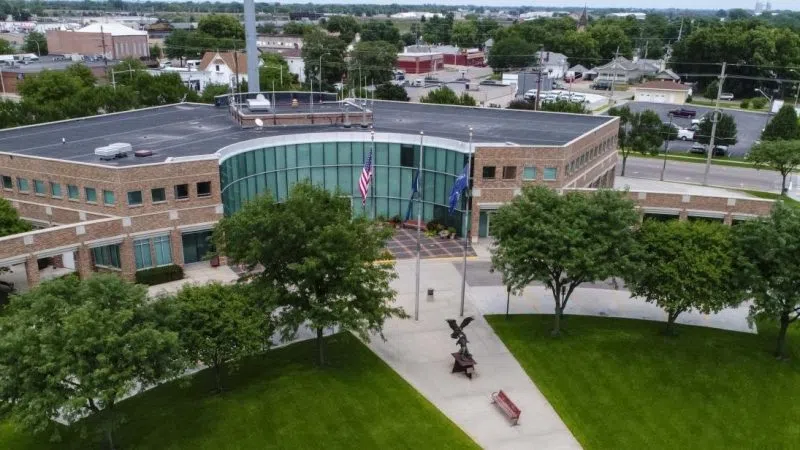
The former McCook Work Ethic Camp, a low-security state prison in southwest Nebraska, became a federal immigration detention center in 2025. Since then, the detention center has held immigrants detained in Nebraska and elsewhere, including Minnesota. Photo courtesy of Nebraska Department of Correctional Services
NEBRASKA — The unprecedented immigration sweeps in Minnesota over the past two months have landed at least 20 detained immigrants in an unexpected place: a Nebraska county jail.
Cass, Lincoln and Sarpy counties all have housed immigrants arrested in Minnesota since December, according to a Flatwater Free Press analysis of federal court documents and reviews of jail rosters. The analysis also found at least seven cases involving a detainee held at the former state prison in McCook that is now a federal immigration detention center.
In court filings and interviews, lawyers have argued that shipping detainees across state lines makes it harder to provide adequate legal representation. Among the complications: Lawyers in Minnesota may not be licensed to practice in Nebraska.
And some fear federal immigration officials are testing the judicial waters in Nebraska in search of more sympathetic judges. Last year, the federal government broke with decades of precedent and argued anyone who entered the U.S. without permission must be detained without bond during deportation proceedings. Since then, judges have issued differing opinions on that change, though the majority have disputed its legality.
“Minnesota has been a very difficult jurisdiction for ICE to win on that issue … So I don’t know this for sure, but my fear is that they’re actually trying to pick who they will be in front of so that they can try and win some of these issues,” said Alexander Smith, an Iowa-based lawyer representing one of the Minnesota detainees.
Immigration and Customs Enforcement did not respond to questions about why immigration officials are moving Minnesota detainees to Nebraska jails.
“We’ve talked to a lot of sheriffs throughout the nation, we have unprecedented cooperation,” Border Czar Tom Homan said during a Feb. 4 press conference in Minneapolis. “I have yet to talk to a sheriff that said no. There are still more sheriffs we are in discussions with and talking to, but I have not heard the word no. I think they want to do the right thing for their communities, too.”
Nebraska is far from the only state housing immigrants detained in Minnesota — a reality that reflects the scope of what the federal government has called Operation Metro Surge. More than 4,000 people have been arrested since the December start of the operation, which has centered on Minneapolis. Many of those detainees have been shipped out of state shortly after their arrests, presenting a bureaucratic nightmare for their lawyers.
“They are supposed to notify us of transfers, but it’s very haphazard as to whether you actually receive a notification,” said Stacey Rogers, a Minnesota lawyer representing an immigrant who was detained at the Lincoln County jail in North Platte. “We’ll schedule something with a client to have a consultation, and then that client doesn’t turn up, and we’re calling the facility, we’re trying to find out what’s happened, where they are, and they say, ‘Oh, that person’s no longer here.’ And that’s how we end up finding out.”
Rapid-fire transfers can also complicate securing legal representation. Smith, the Iowa-based lawyer, started representing his client after he was transferred to Nebraska because his previous counsel wasn’t licensed to practice in the state.
“That’s where our office is coming in a lot,” Smith said. “Some Minnesota attorney reaches out, says, ‘Oh, crap, I need some help with somebody in Nebraska.’”
Number unclear
Flatwater documented the presence of Minnesota detainees in Nebraska by examining habeas corpus petitions, filings that challenge the government’s legal authority to detain someone and seek their release from custody or the opportunity for a bond hearing.
Since December, more than a dozen Minnesota detainees have filed petitions. Seven have been granted bond hearings, and three have been ordered released.
The petition numbers undercount the total number of Minnesota detainees in Nebraska. Immigrants facing deportation are not provided a government-appointed lawyer, placing the onus of finding and paying for representation on them in many cases.
Lieutenant Penny L. Ball with the Lincoln County Detention Center told Flatwater that the jail received 19 detainees from Minnesota, four of whom had since been removed or released. As of Feb. 4, 15 remained in custody.
A Sarpy County communications manager said the county’s detention center is currently holding one Minnesota transfer. Cass County Sheriff Robert Sorenson said his office doesn’t comment on detention matters for safety reasons. ICE did not respond when asked how many Minnesota detainees are being held in McCook. The center opened with the capacity to hold 200 detainees, and an expansion is underway.
The counties have intergovernmental agreements, where they collect a fee for housing federal detainees. Lincoln County receives $74 a day per detainee, while Sarpy County receives $100 a day.
Solomon Steen, a Minnesota lawyer representing an immigrant who was detained at the McCook Detention Center and later ordered released, said he expects immigrants will be shipped to more states as the administration’s preferred detention sites reach capacity.
“What I’ve seen in terms of data is about a four times increase in arrests and a four to five times increase in removal,” he said. “So I would assume a lot of this is just the administration figuring out where they have a conveyor belt where they can get people removed as quickly as possible … following that pattern until they exhaust their capacity there, and then start looking at other places that can either warehouse people or remove people.”
Nebraska’s federal judges have seen an influx of detention challenges as the Trump administration increases immigration enforcement across the country. In January alone, 16 immigrant detainees filed petitions seeking relief in the District Court of Nebraska. By comparison, 10 were filed in Nebraska from 2017 to 2024. Twenty-six were filed in 2025, largely driven by an immigration raid at Glenn Valley Foods last summer.
At issue is a reinterpretation of longstanding immigration law. In July, ICE and the Department of Justice announced immigrants who arrived in the U.S. illegally and lived there for years would no longer be eligible for bond hearings in front of an immigration judge.
Previously, mandatory detention without bond was generally reserved for a specific class of immigrants — those who had recently crossed the border seeking admission to the U.S. Immigrants who had entered without presenting themselves to immigration authorities and lived in the U.S. for an extended period of time were generally eligible for bond hearings, where they could argue for their release during deportation proceedings.
After a Board of Immigration Appeals ruling in September, the policy change became binding for immigration judges, who are separate from the federal judiciary and handle deportation proceedings.
But it is not binding for district judges, tasked with assessing habeas claims. Court documents show Nebraska district judges have varied in their willingness to accept the government’s argument for mandatory detention of all immigrants. While judges Susan Bazis, Joseph Bataillon and John Gerrard have ruled in favor of detainees, two others — Brian Buescher, a Trump appointee, and Robert Rossiter, an Obama appointee — have been more receptive to the government’s position.
Buescher and Rossiter have both been assigned habeas cases filed by the Minnesota detainees, but have yet to issue rulings.
On Friday, the Fifth Circuit became the first appeals court to hear the government’s argument in favor of mandatory detention — and ruled 2-1 in the Trump administration’s favor. The Eighth Circuit, which includes Nebraska, has a case of its own pending on the same issue.
“For months, activist judges have ordered the release of alien after alien based on the false claim that DHS was breaking the law. Today, the first court of appeals to address the question ruled that @DHSGov was right all along,” Department of Homeland Security Secretary Kristi Noem wrote in a social media post after the ruling.
‘These are all people’
The circumstances and origins of the Minnesota immigrants challenging their detention in Nebraska vary. Several are originally from Ecuador. Others are El Salvadoran, Somalian or Mexican.
At least two who have filed habeas petitions have pending applications for U Visas, meant for victims of violent crime. Another has applied for a T Visa, intended for victims of trafficking.
Most of their arrests flew under the radar. But the arrest of one man, Somalian refugee Abdulkadir Sharif Abdi, received national media attention after ICE described him as an active gang member, a description that community members contested.
Abdi has been convicted of multiple crimes, including theft of property, shoplifting and disorderly conduct, but had since become an addiction recovery leader, according to CBS News. He had previously been detained in 2018, but was released after a successful habeas petition.
After his arrest in December, Abdi was transferred to the Lincoln County Detention Center in North Platte. The community there is no stranger to ICE detentions; more than 60 immigrants arrested during the Glenn Valley Foods workplace raid, four hours away, were detained there.
HOPE-Esperanza, a nonprofit serving North Platte’s minority community, agreed to provide translation services and other support to the Glenn Valley detainees, support that Lincoln County Sheriff Jerome Kramer said was essential at a time when the jail was understaffed and navigating a large increase to its population.
Six months after the Glenn Valley raid, HOPE-Esperanza received a call from a legal advocate inquiring about whether Abdi and several other detainees were being held in Lincoln County. TinaMaria Fernandez, founder of the nonprofit, passed the inquiry on to jail administrators, who confirmed his presence.
“We always take every effort to get them in touch with an attorney to get their case heard,” Kramer wrote in an email to Flatwater.
Abdi ultimately filed a habeas petition on Dec. 9 claiming his detention was unlawful, and Bazis, the judge presiding over his case, ordered his interim release on Dec. 23 after the government indicated it would not contest his petition.
“The Court is aware of, and respects, the Executive Branch’s need to enforce our nation’s immigration laws,” Bazis wrote in her ruling. “The Court reiterates that its conclusions as to Abdi’s constitutional claims are driven by the Federal Respondents’ decision not to respond to the petition and the practical result that Abdi’s evidence is uncontroverted.”
Abdi got out of jail on Christmas Eve. Kramer said he took him to HOPE-Esperanza, where Fernandez helped him contact his family and get clean clothes, food and a hotel room for the night. The organization also helped his family navigate booking a flight to Minneapolis for his return on Christmas Day. Fernandez admitted she thought it would take a “Christmas miracle” to get him boarded.
“All we had was the immigration paperwork,” she said. “I had his wife send me a photocopy of his driver’s license … And I thought, how are we going to get him on this plane without TSA- compliant documentation? Because ICE had kept all of that.”
Fernandez explained the situation to the TSA agents, provided them with the copy of his license and the federal ruling ordering his release, let them know she had Kramer on standby to verify and waited as the agents conducted the necessary checks. By the end, they had gotten their miracle — Abdi made it home to his wife.
He isn’t the only released immigrant from out of state who HOPE-Esperanza has helped. Fernandez said they assisted an individual from South Dakota as well, and they have even fielded calls from people seeking assistance from Florida.
“Everybody needs information in their own language, they all need help navigating,” she said. “When you’re let out of the county jail in North Platte, Nebraska, and you’re from South Dakota and you don’t have a cellphone and you don’t have ID and you don’t have any money, what are you supposed to do?”
The Flatwater Free Press is Nebraska’s first independent, nonprofit newsroom focused on investigations and feature stories that matter.