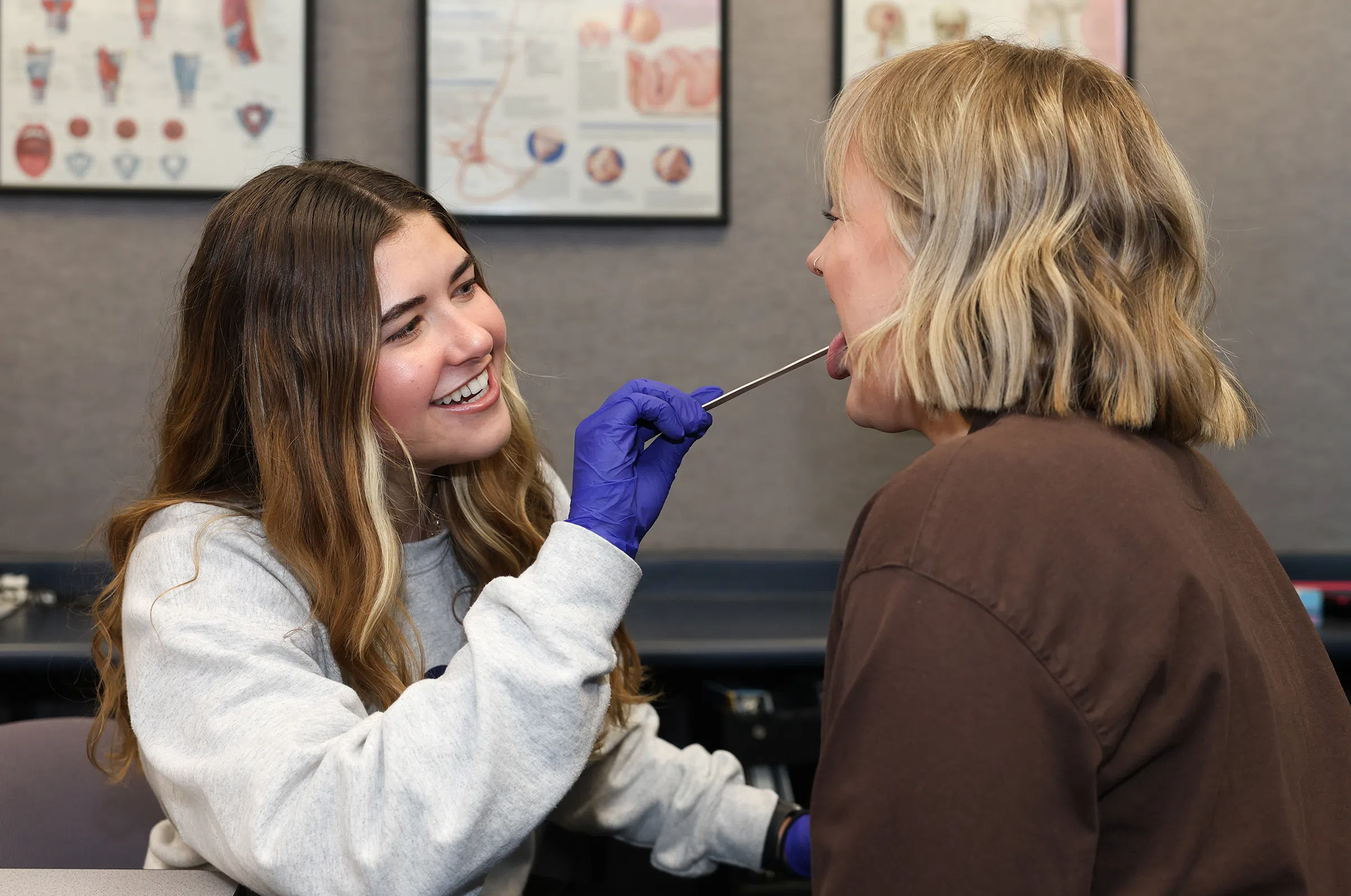
Enrollment in UNK’s speech-language pathology program has grown significantly in recent years, reflecting both rising workforce demand and the department’s expanding reach through on-campus and online pathways. (Photo by Erika Pritchard, UNK Communications)
KEARNEY – Some careers are defined by profits and promotions.
This one is measured by moments – a child’s first words, a teenager gaining the confidence to speak up in class, a stroke survivor forming a full sentence again.
That’s the work of speech-language pathologists, who help people find, strengthen or reclaim something profoundly powerful: their voice.
At the University of Nebraska at Kearney, preparing professionals for these moments is a commitment shaped by community needs and human impact.
“To me, the biggest thing is the reward that comes with helping others. Being able to give someone their voice back or help a child develop the ability to communicate their wants or needs more clearly. It’s really rewarding to be part of that process and to help people better communicate with those around them,” said Whitney Schneider-Cline, an associate professor and chair of UNK’s Department of Communication Disorders.
JOBS ARE EVERYWHERE
Through its undergraduate major in communication disorders and master’s program in speech-language pathology, UNK is building a pipeline of graduates ready to serve residents across Nebraska and beyond. Enrollment in the programs has grown in recent years – particularly at the graduate level – reflecting both rising workforce demand and the department’s expanding reach through on-campus and online pathways.
This demand shows up in school districts searching for clinicians, hospitals expanding rehabilitation services and rural communities working to meet the rising needs of aging populations.
“There’s been a shortage of speech-language pathologists since I entered the field,” said Schneider-Cline, who earned bachelor’s and master’s degrees from UNK and worked in the field before returning as a faculty member. “Programs are getting more and more professionals out there, but we have more need with baby boomers getting older and needing more services and young children getting identified earlier and needing more services, too.”
According to the U.S. Bureau of Labor Statistics, employment of speech-language pathologists is projected to grow 15% from 2024 to 2034, much faster than the average for all occupations. The median annual wage for these positions was $95,410 in May 2024.
“Our students graduate from the program and have a job, wherever they want, doing whatever they want,” Schneider-Cline noted. “There’s a huge need, which is a problem, but at the same time for our graduates it’s a benefit because they can find jobs wherever they want to be.”
The undergraduate major has a steady enrollment of about 70 students while the graduate program has seen significant growth. Five years ago, fewer than 40 students were pursuing a master’s degree in speech-language pathology. That number has since climbed to more than 110, fueled in part by the launch of UNK’s online speech-language pathology option in 2020.
The expansion was rooted in the department’s longstanding mission to serve rural Nebraska.
“It all started because we had a student commuting from the Panhandle,” Schneider-Cline explained. “A four-hour drive, here and back, leaving her family behind for the week so she could be here for the grad program. We thought, ‘There’s got to be a better way.’”
The solution not only reduced long drives across Nebraska but also expanded UNK’s reach far beyond state lines. Now, graduate students log in from locations throughout the country, from the Virgin Islands to Alaska to Hawaii.
Even with a national footprint, the department has worked intentionally to preserve the close-knit culture that defines it.
“Regardless of modality, what we do at UNK is take care of our students,” Schneider-Cline said. “We’re small enough that we know our students, so we’re able to work with them to develop the skills they need and give them the support they need to be successful.”
The online graduate program, structured part time over nine semesters, was designed for working professionals and nontraditional students balancing careers and families. Clinical experiences are completed in schools and medical settings near students’ homes, while faculty maintain consistent oversight and mentorship.
In addition, UNK offers online leveling coursework for students who hold bachelor’s degrees in other disciplines but want to pursue speech-language pathology. The 11-course sequence prepares them to apply for graduate programs in speech-language pathology or audiology.
“If you have a bachelor’s degree in anything outside our field, you can take this series of courses and then be eligible to apply for a grad program,” Schneider-Cline said.
BUILDING A FOUNDATION
Speech-language pathologists serve individuals from birth to end of life, working in schools, hospitals, nursing homes, private clinics, rehabilitation centers, research facilities and higher education settings.
UNK’s undergraduate major in communication disorders provides the academic foundation students need to pursue graduate study and professional credentials. Students engage in research, professional activities and hands-on learning experiences that prepare them for advanced study and clinical practice.
Senior Lainey Sheffield, who will graduate in May with a bachelor’s degree in communication disorders, discovered the field after initially starting as a math education major.
“My parents both instilled in me a desire to help others,” said Sheffield, who is from Council Bluffs, Iowa. “I just fell in love with the process of starting with someone from square one and helping them work toward their goal. I haven’t looked back since.”
She points to the faculty as one of the program’s greatest strengths.
“I love the guidance from the professors,” she said. “They all are very knowledgeable in different aspects of what you can do with the degree. We have a lot of professors who were in schools but then also some who were on the medical side. Being able to hear their input while they’re teaching classes has been super beneficial to prepare for what I’m going to see in the real world.”
Sheffield chose UNK largely because it already felt familiar. Both of her parents are alumni, and many of her extended family members live in the Kearney area.
“As the oldest of five, I really wanted a place that felt like home – both in a school sense and a community sense,” she said. “Kearney just felt like the perfect fit.”
That sense of belonging has extended beyond the classroom. Sheffield serves as president of the Kearney Student Speech Language and Hearing Association, helping organize professional development activities and community outreach initiatives. The group led projects that brought communication boards to Kearney Family YMCA and Harmon Park, and members volunteer with TOPSoccer and local assisted living facilities.
Additionally, Sheffield has shadowed professionals at CHI Health Good Samaritan, area elementary schools and a pediatric physical therapy clinic, gaining exposure to both educational and medical settings. Those experiences have broadened her perspective as she prepares for graduate school.
“That’s truly why I love the program,” she said. “With this degree, I’ll have the opportunity to work with individuals across the lifespan, and that’s something I’m incredibly excited about.”
Undergraduates also participate in research through programs such as the Summer Student Research Program and Undergraduate Research Fellows, working alongside faculty in spaces like the UNK Language and Cognition Lab.
For students ready to accelerate their path, UNK offers a fast-track option that allows seniors to take coursework counting toward both undergraduate and graduate degrees, reducing the graduate course load and saving money.
LEARNING BY DOING
At the graduate level, hands-on experience begins almost immediately.
“It’s kind of scary – they just throw you in that first week and you are doing all of this hands-on stuff,” said Kylie Baumert, a Sutton native pursuing her master’s degree in speech-language pathology. “But that’s really how you learn. You can sit in classes all day and learn all the material, but until you’re doing it in person, hands-on, that’s when you really start to learn and gain that experience.”
Graduate students complete four semesters in the on-campus Speech, Language and Hearing Clinic, where they work directly with clients under the supervision of licensed clinical educators. The clinic serves clients of all ages and offers therapy at no cost to families thanks to support from the NU Foundation and Scottish Rite Foundation.
The department also operates the RiteCare Telepractice Clinic, delivering free speech therapy services to underserved rural populations via secure internet connections. In addition, specialized programs such as SPEAK OUT! – an evidence-based therapy for individuals with Parkinson’s disease and related neurological disorders – expand clinical opportunities while serving community needs.
Last semester, Baumert worked with a 10-year-old boy through telepractice and provided accent modification services for international students on campus. She’s currently providing cognitive-communication therapy for an elderly woman with dementia and serving clients through the SPEAK OUT! program.
“I think communication is one of the most important things in life, and we have the opportunity to help people achieve that,” Baumert said. “I want to see people get better and I want to know that I’m helping people.”
After completing their on-campus clinical rotations, graduate students transition into two final internships – one medically based, working primarily with adults, and the other focused on children – allowing them to apply their training in community settings before graduation.
“That is really what makes our program function,” Schneider-Cline said of the department’s strong partnerships with local providers. “With the shortage in the field, placements where we can send students are so valuable. We nurture those partnerships as much as we can because they’re so important to our program.”
SERVING RURAL NEBRASKA
For many graduates, that preparation translates into meaningful work back home.
Emily Mahr, who earned her bachelor’s degree in 2020 and master’s degree in 2022, now serves as a speech-language pathologist at Sidney Regional Medical Center, a 25-bed critical access hospital in western Nebraska. Returning to her hometown was always part of the plan.
“In the back of my mind, that was definitely always my goal,” said Mahr, who grew up on a farm outside Sidney. “I feel like the roots run a little deeper when you come back and serve the community that you grew up in and that served you. It’s a little more meaningful.”
Mahr’s connection to rural health care started early. Her mother works at the hospital as a medical laboratory technician, and some of her siblings also pursued careers in health care.
“Rural health care has always been a passion for me,” she said. “I got to see the work my mom did in a hospital setting and the impact she had on the patients she was serving. That kind of piqued my interest.”
An undergraduate internship at Sidney Regional Medical Center helped solidify her path. The experience provided a broad overview of how departments within the hospital work together and ultimately opened the door for her return after graduate school.
“That internship really allowed me to see what our hospital is like and how we all work together,” Mahr said. “It showed me that it was a really great environment to work in.”
Today, she serves patients of all ages in inpatient, outpatient, long-term care and transitional rehabilitation settings. The diversity of cases – from pediatric speech and language services to adult patients recovering from illness or injury – is one of the aspects she values most.
“We serve birth to end of life here, and we get to provide care in different settings within one facility, which is really kind of fun,” she said. “You’re able to follow patients, see their progress and walk alongside them through that transition.”
Since returning to Sidney, Mahr and fellow UNK graduate Brenna Simmons have helped grow the hospital’s speech therapy department, expanding services to better meet community needs.
“There’s a need for a speech-language pathologists in these areas,” Mahr said. “We’ve really grown and provided new services in our community.”
That growth has been supported by hospital leadership and strong community backing, she added, a reminder that rural health care relies on teamwork.
“We’re really lucky to have the services we can provide here and the strong community support,” Mahr said. “It’s rewarding knowing that your work is making an impact.”
LOOKING AHEAD
The UNK department’s next move is designed to enhance its ability to serve rural Nebraska.
By relocating to the new Health Science Education Center II, communication disorders will embed its students in a shared health sciences environment that mirrors the team-based care model common in rural communities. The transition, expected to occur before the fall semester, will place the Speech, Language and Hearing Clinic alongside University of Nebraska Medical Center programs inside the three-story, 110,000-square-foot facility on UNK’s west campus.
For speech-language pathology students, this will create more opportunities to work side by side with future nurses, physicians, therapists and other health providers in a state-of-the-art building designed for collaborative, interprofessional learning.
“Having our clinic right there where they are gives us greater opportunities to partner with UNMC and bring them into our clinic, working directly with patients and our students,” Schneider-Cline said. “That’s how it works in the real world.”
All faculty offices and the clinic will move into the $95 million facility, with hopes that classroom instruction will also take place there, further integrating students into the health sciences environment.
For a program built around restoring communication and strengthening community health, the new location represents more than a change of address. It reinforces UNK’s commitment to preparing professionals who can step into rural clinics, schools and hospitals ready to collaborate, serve and embrace the moments that matter.
That sense of purpose is what makes the field so powerful.
“Communication drives our everyday lives,” Sheffield said. “Something as simple as saying ‘I love you’ to your parents or communicating that you need water or food – it’s something that we do every single day. For me, it’s very inspiring to know that I can help somebody regain or develop that ability.”