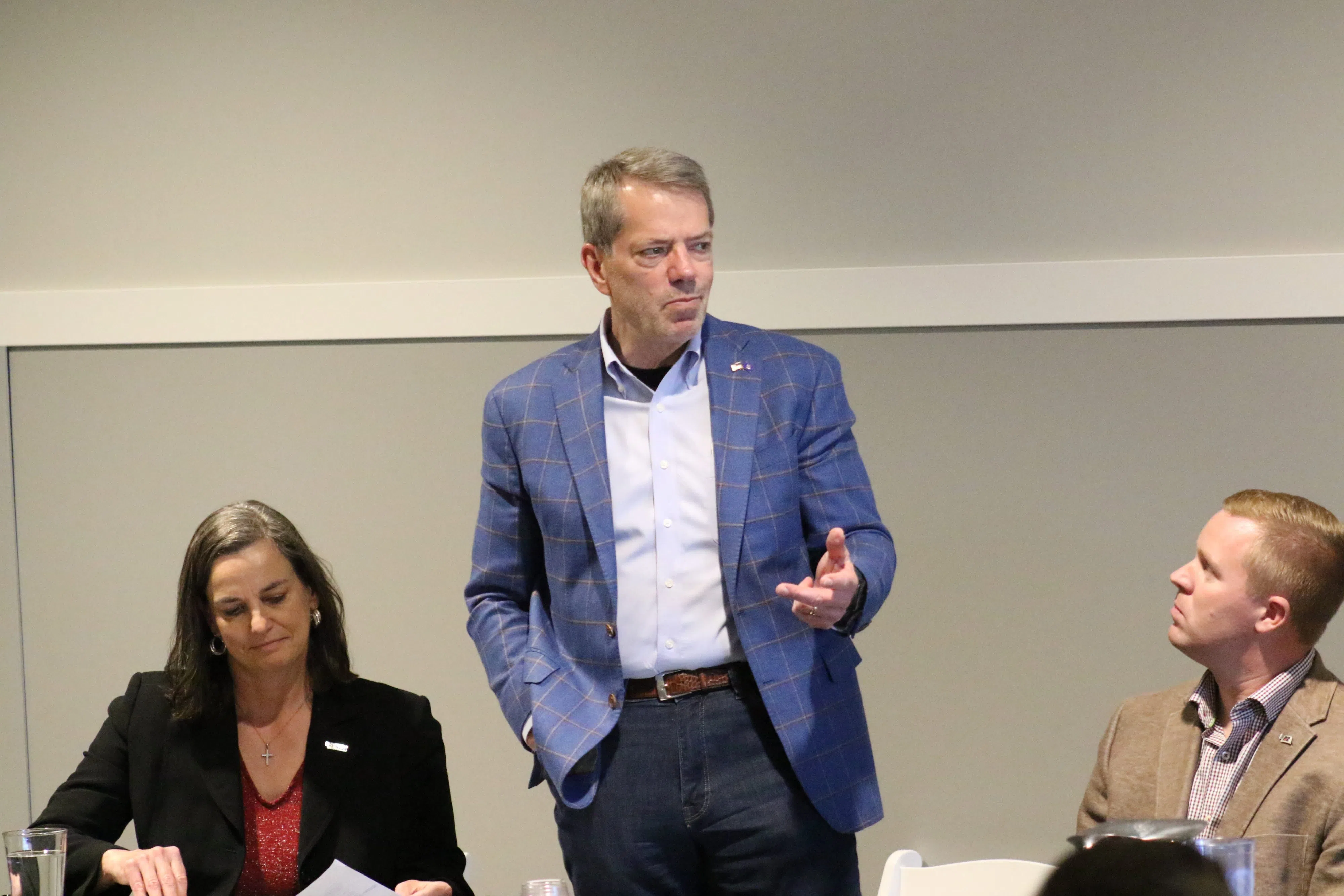
Governor Jim Pillen speaks at the value-added ag roundtable in Hastings on Monday, March 18, (Brian Neben, Central Nebraska Today)
HASTINGS — Governor Jim Pillen took part in National Ag Week with a series of stops across Nebraska. The first stop of the week included attending a value-added ag roundtable discussion in Hastings on Monday, March 18.
In addition to the roundtable, Pillen toured Hastings based businesses including Chief Ethanol, Tallgrass and Heartwell Renewables.
Several representatives of these businesses also took part in the discussion, which was held at the Blue Fork Kitchen.
Value-added agriculture refers most generally to manufacturing processes that increase the value of primary agricultural commodities.
Value-added agriculture may also refer to increasing the economic value of a commodity through particular production processes, e.g., organic produce, or through regionally branded products that increase consumer appeal and willingness to pay a premium over similar but undifferentiated products.
The roundtable discussion mostly focused on ethanol production.
Governor Pillen started off the conversation with a bold statement, saying that Nebraska should focus on not exporting a single kernel of corn, and bring the production home, rather than sending it abroad.
“We have given too much topsoil away,” Pillen added.
He said farmers own the technology to be able to fully take advantage of their products, and in a similar vein, said that broadband needs to be expanded across the state so all ag producers have the same access to fast internet.
Pillen also said that Nebraska could be a leader in carbon sequestration, the capturing, removal and storage of carbon dioxide (CO2) from the Earth’s atmosphere. It has been recognized as a key method for removing carbon from the atmosphere.
He also said that Nebraska ag producers need to come together as a team with the same goals. This can help to lead economic growth for rural communities.
Lance Atwater, Second Vice President of the Nebraska Farm Bureau and a farmer in the Adams, Webster County area also spoke at the roundtable.
As a younger farmer, Atwater said profitability is a key issue and guides most of his decisions.
He said he agreed with Pillen’s idea to keep corn in the state, he said that way famers would not be reliant on outside entities and referenced the most recent trade war with China.
He said for young farmers, profitability and stability are key. He also added that he wants as much information as possible when it comes to processes like carbon sequestration so he can make the best decisions for his operation.
Pillen added that keeping a lower carbon score is already a benefit for farmers and going into the future will be even more important for producers as consumers ask for lower carbon use.
Wayne Garrett, General Manager for Chief Ethanol Fuels, spoke and noted that ethanol is a 15-billion-dollar gallon production in United States.
In that vein, Garrett also touched on carbon intensity (CI) scores, which is the emission rate of a given pollutant relative to the intensity of a specific activity, or an industrial production process.
Nebraska farmers will be able monetize lower CI scores.
Alison Nelson, Vice President of Business Development with Tallgrass, said her company operates 10,000 miles of natural gas pipeline.
Tallgrass recently announced a project to convert its Trailblazer natural gas pipeline to CO2 transportation service, establishing an approximately 400-mile CO2 pipeline to serve as the backbone of a regional CO2 transportation system.
“This project will allow us to capture, transport and permanently sequester over 10 million tons of CO2 per year from industries in Nebraska, Colorado, and Wyoming. In support of this investment, Tallgrass is developing a commercial-scale CO2 sequestration hub in southeastern Wyoming, partially funded from a grant from the Wyoming Energy Authority,” stated.
Chad Wolfe, Senior Research Associate with the U.S. Meat Animal Research Center, mentioned distillers’ grain, which is a co-product of the ethanol production process and a low-cost alternative feed ingredient that cattle producers have come to use heavily.
He noted that distiller’s grain was used in great quantity to feed cattle during the most recent drought spells in 2023 and 2022.
Pillen returned to the floor and spoke about the monies available through the federal government. He added that there needs to be a shift in ag producers to be more willing to accept federal funds, in part so Nebraska can compete with neighboring states.
Pillen also spoke to the rapid growth of technology and said of today’s ag producers, “We are in the technology business, we just happen to farm.”