HASTINGS — May was an active weather month, with St. Paul seeing its wettest May on record. The Tri-Cities saw higher than average precipitation amounts, and drought conditions continued to ease.
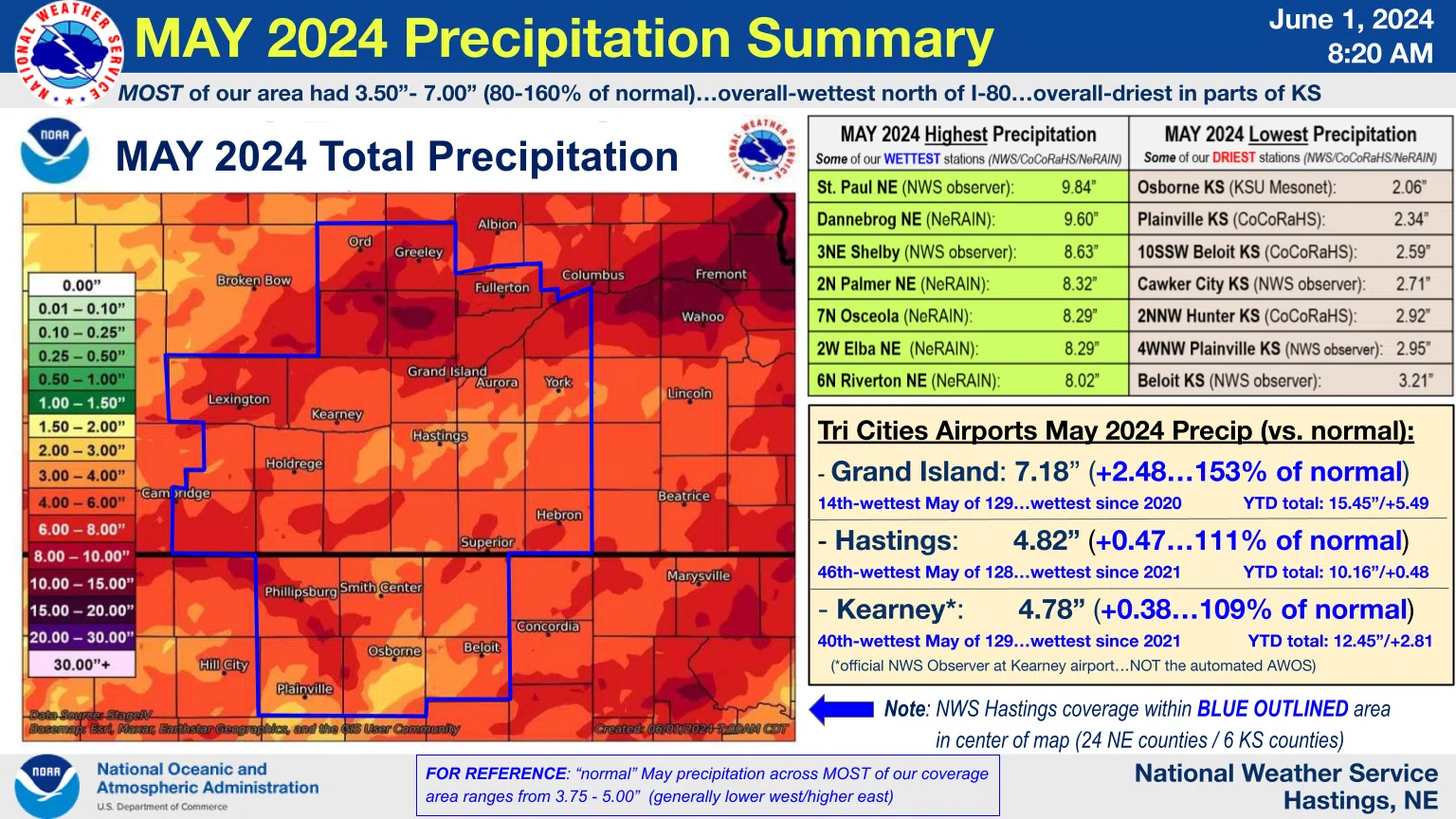
According to the National Weather Service – Hastings, most of their coverage area saw between 3.50 and 7.00 inches, with the overall wettest areas being north of Interstate 80 and the driest regions being located in their six north central Kansas counties.
Recording its wettest May on record, St. Paul had 9.84 inches of rain, followed by Dannebrog, 9.60 inches, Shelby, 8.63 inches, Palmer, 8.32 inches, Osceola, 8.29 inches, Elba, 8.29 inches and Riverton, 8.02 inches.
The driest locations were all in Kansas, Osborne, Kan., had the lowest recorded amount with 2.06 inches, followed by Plainville, Kan., at 2.34 inches and Beloit, Kan., at 2.59 inches.
The following was observed at the Tri-Cities airports:
- Grand Island: 7.18 inches, 153 percent of normal, 14th wettest May on record
- Hastings: 4.83 inches, 111 percent of normal, 46th wettest May on record
- Kearney 4.78 inches, 109 percent of normal, 40th wettest May on record
For reference, normal May precipitation across the region ranges from 3.75 inches to 5.00 inches, lower in the west and higher in the east.
The continued rainfall throughout May helped to lessen the drought conditions across Nebraska. Per the latest update on May 30 from the U.S. Drought Monitor indicated only a broad swath of moderate drought, D1, conditions across southeast Nebraska.
Locally, the moderate drought conditions do extend to Adams, Clay, Fillmore and the northern portions of Nuckolls and Thayer counties. Abnormally dry, D0, conditions linger in southern Hall County while Buffalo County is completely free of drought conditions.
“Severe drought (D2) was improved in south-central Kansas, while improvements to moderate drought (D1) and abnormal dryness (D0) were made in northern Kansas and southeast Nebraska,” per the U.S. Drought Monitor.
On the other hand, “Abnormal dryness was expanded in parts of Colorado, eastern Wyoming and western Nebraska this week,” per the U.S. Drought Monitor.
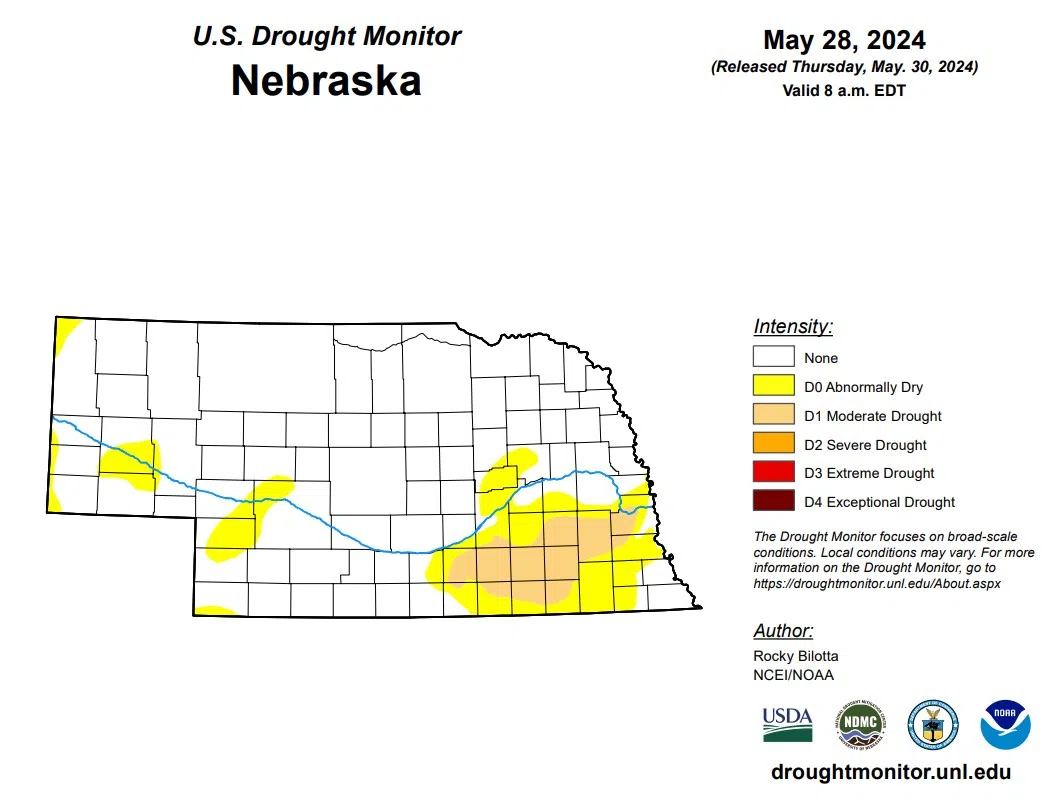
U.S. Drought Monitor, Courtesy