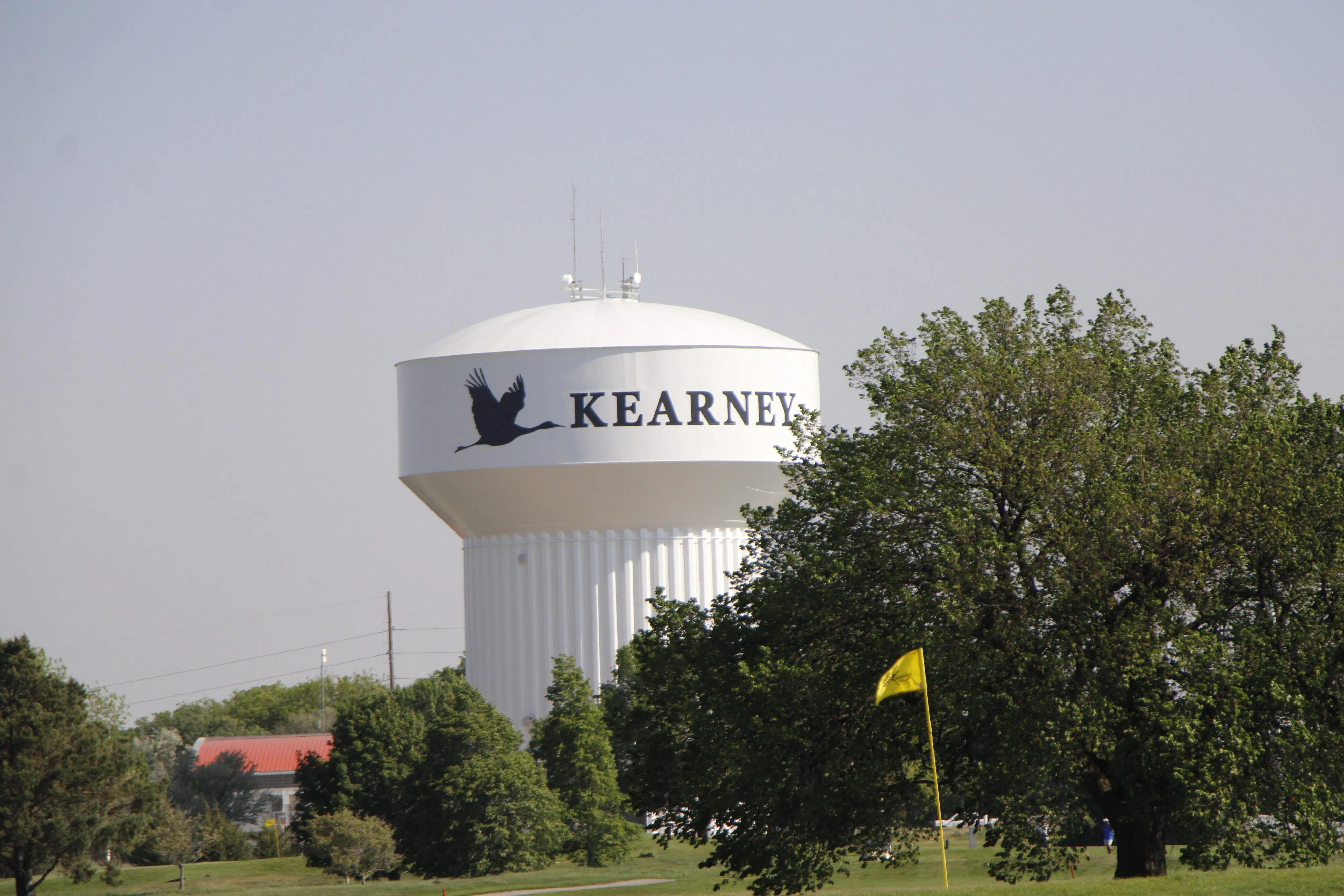
The 1.5-million-gallon water tower near 30th Ave. and 39th St., (Brian Neben, Central Nebraska Today)
KEARNEY — The Kearney city council received an information presentation from Miller & Associates regarding the City of Kearney Utility Growth Survey during their meeting on Tuesday, May 13.
Prior to the presentation, Brenda Jensen, City Manager, said that with several new council members having joined, it would be beneficial to review the city’s utility growth survey, which helps detail infrastructure plans and priorities, as well as how these impacts future growth of the community.
The presentation was delivered by Craig Bennett of Miller & Associates, who reviewed both the sewer and water master plans and compared them generally to a one-and-six-year road plan.
Bennett noted Kearney’s growth in certain directions and noted in 1993, there was around 5,320 acres of develop area in Kearney served the sanitary and sewer infrastructure.
Jump ahead to 2025, there are now 9,962 aces of developed areas served, which is around 15.5 square miles, Bennett said.
In 1992, a north sewer study had been conducted to determine the best ways to allow for development on the north side of Kearney.
Bennett said through careful planning, effort and willingness to invest, several lift stations were constructed that ultimately allowed the northward development of Kearney to occur over the subsequent years.
Around 1,527 acres were developed on the north side of Kearney.
A similar study was conducted in 1999 that focused on the southwest side of Kearney and the extension of sewer lines through this area would allow for the development of Yanney Park, Kearney Regional Hospital, Kearney High School in 2016 and the north side of the Younes complex.
In planning for the future, Kearney’s sewer lines at the moment could handle a population equivalent of over 43,000, higher than the 34,000 people recorded in 2023. Thus, the sewer line is only at 64 percent of its total capacity. There is around 3.6 million gallons used per day as an average use.
Jensen said when people ask why Kearney isn’t developing more in certain areas, she noted that the topography of the community plays a role. She noted that the land rises toward the northwestern side of the community and gravity matters when it comes to the flow of sewer and water lines.
It was noted lift stations are possible, but are expensive to build and to maintain.
Turning to the water master plan, Bennett said Kearney is primarily served by the northwest well field and the Island well field in the Platte River on the southeast side of Kearney.
It was noted the well fields can supply 29 million gallons per day, but the average daily use is only 6.1 million gallons per day, with the peak average in the summer months being 14.6 million gallons per day.
Kearney is served by three different water towers, the 1.5-million-gallon tower near 30th Ave. and 39th St., the two-million-gallon tower at W. 48th St. and the two-million-gallon tower on N Ave. and E. 48th St.
Bennett noted that there is 233 miles of water line and 199 miles of sanitary sewer line in Kearney, which would reach from Kearney to Iowa City if laid out in a line, Bennett said.
Bennett also touched on the 2024-25 Clean Water Needs Survey, which highlights sewer and water line infrastructure projects that are on the list to be completed in the future. Bennett noted that most of them have to deal with adding in redundancy into the system.