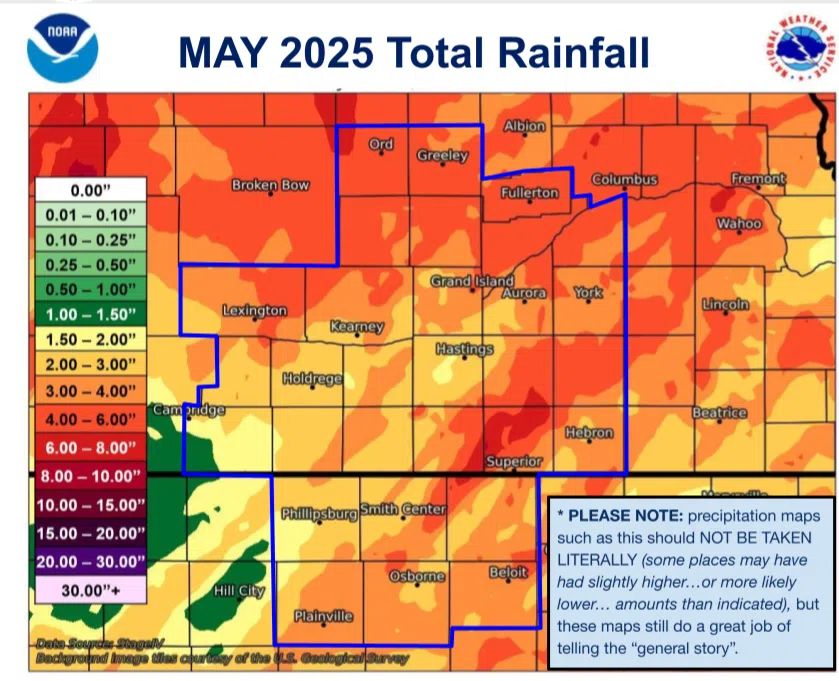
May 2025 precipitation, (NWS Hastings, Courtesy)
KEARNEY — After a dry start to 2025, beneficial rainfall fell during May, but it could not fully suppress the ongoing drought conditions in central Nebraska.
According to the National Weather Service – Hastings, most of their county warning area saw between 1.50 and 4.50 inches of precipitation, with the driest areas being in the southwest and wettest being in the southeast and far north.
The areas that saw the highest precipitation in May included Oak, a village in Nuckolls County, saw 7.29 inches, Lawrence saw 7.24 inches, Nora saw 6.71 inches and Guide Rock saw 6.34 inches.
The areas with the lowest precipitation amounts included Beaver City, 1.02 inches, Wilsonville, 1.25 inches, Cambridge 1.41 inches and Holdrege, 1.42 inches.
The Tri-Cities saw varied amounts of rainfall last month:
- Grand Island, 3.14 inches, 67 percent of normal, driest since 2023
- Hastings, 1.67 inches, 38 percent of normal, driest since 2023
- Kearney, 2.98 inches, 68 percent of normal, driest since 2023
For reference, normal precipitation in May ranges from 3.75 inches to 5.00 inches, according to NWS Hastings.
Ongoing drought conditions are still in place across the state and were only slightly impacted by the rainfall. A large swath of severe drought, D2 conditions, is in place across south central Nebraska with a notable hole of moderate drought, D1, conditions in Dawson and Custer counties.
“From May 24-26, widespread precipitation (1 to 3 inches, locally more) resulted in a 1-category improvement to portions of southwestern South Dakota, Nebraska, Kansas, and northeastern Colorado,” per the U.S. Drought Monitor, “Much cooler temperatures accompanied this widespread precipitation which contributed to topsoil moisture recharge.”
“Severe (D2) to extreme (D3) drought was reduced in coverage across central to western Nebraska along with adjacent areas of southwestern South Dakota,” per the U.S. Drought Monitor, “Southern Nebraska and northern Kansas missed out on this past week’s precipitation and a couple of small 1-category degradations were made.”
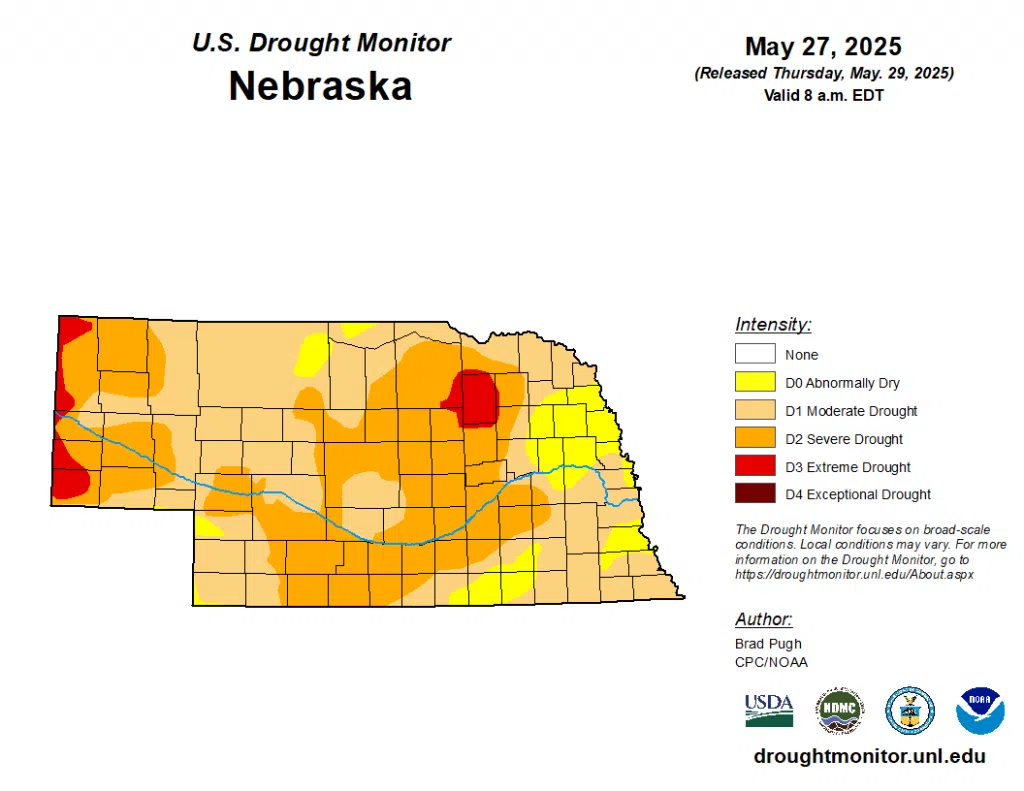
Drought conditions across Nebraska as of May 27, (U.S. Drought Monitor, Courtesy)