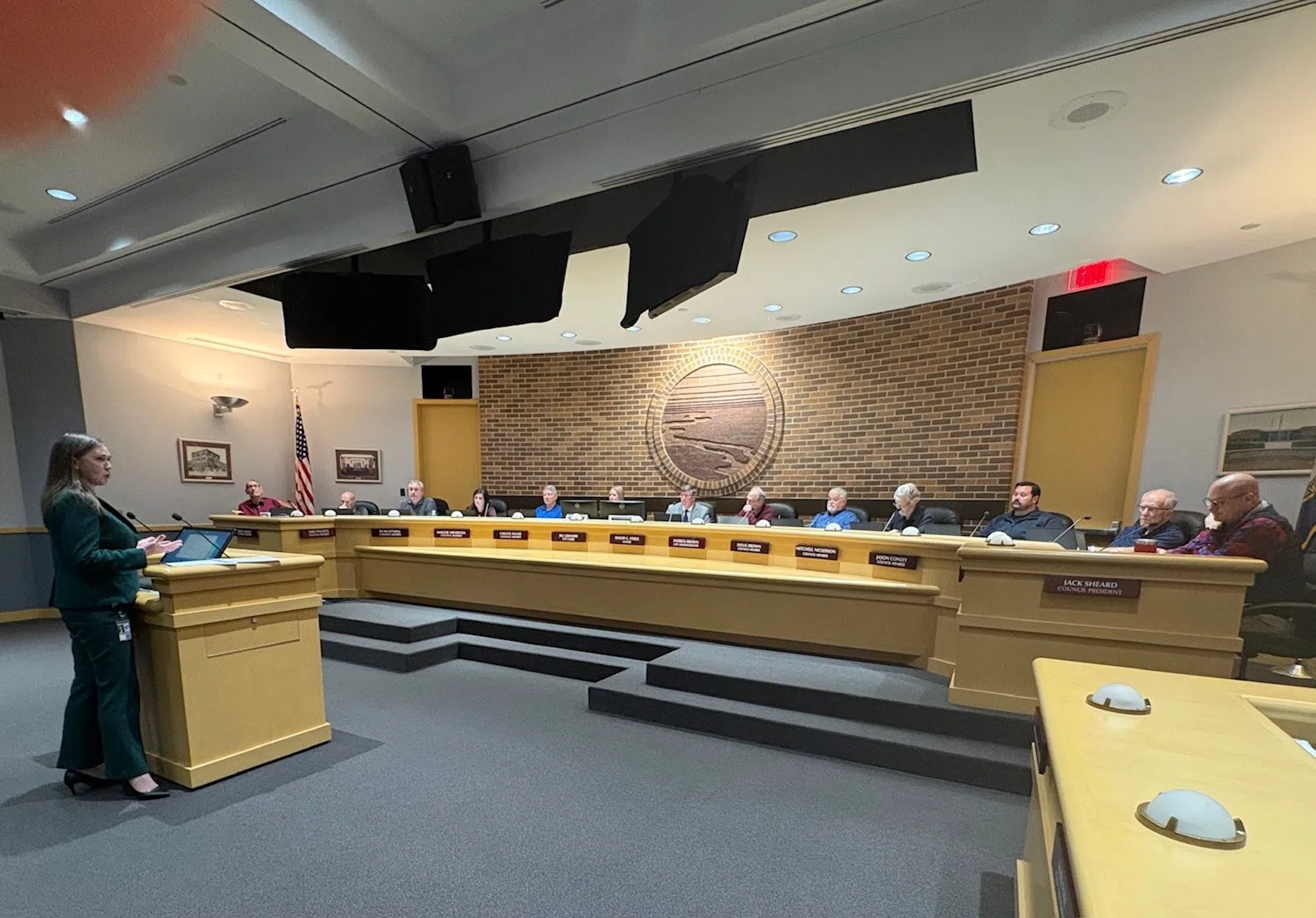
Grand Island City Attorney Kari Fisk addresses City Council Nov. 4 about amending a city ordinance to help prevent cryptocurrency fraud. (Carol Bryant, Central Nebraska Today)
GRAND ISLAND – The Grand Island City Council unanimously approved Nov. 4 making a change to a city ordinance concerning cryptocurrency kiosks.
The ordinance now requires signage near machines to help prevent fraud.
A cryptocurrency machine allows people to buy or sell cryptocurrencies such as Bitcoin using cash or a debit card.
A memo from Mayor Roger Steele and City Attorney Kari Fisk sent to City Council said, “Most people are being scammed through cryptocurrency kiosk schemes, and more victims are losing money, including right here in Nebraska. Especially vulnerable are older adults. According to the Federal Trade Commission, people aged 60 and over were more than three times as likely as younger adults to report a loss using a cryptocurrency kiosk. These kiosks have increasingly facilitated elder fraud, especially among tech/customer support scams, government impersonation, romance scams, emergency/person-in-need scams, and lottery/sweepstakes scams.”
“In its most basic form, cryptocurrency kiosks are a simple and familiar way for individuals to convent flat currency (like dollars, Euros, or pounds) into cryptocurrency. Cryptocurrency kiosks are unstaffed machines which look like traditional ATM bank machines. They are often found in convenience stores, gas stations, and other high traffic areas. Instead of distributing cash, they accept cash in exchange for cryptocurrency. Criminals are known to give detailed instructions to their victims, including how to withdraw cash from their bank, locate a kiosk, and then use the kiosk to deposit the cash to buy and send virtual currency to the criminals in irreversible transfers,” the memo said.
“Today, there are more than 45,000 cryptocurrency kiosks nationwide. In Nebraska, over 200 of these machines are available across the state, and roughly 30 are available in Grand Island,” the memo said.
“This ordinance is designed to create mandatory, proactive measures to protect our citizens from the growing threat of fraud associated with these machines,” the memo said.
“One way to mitigate these crimes is to require clear, visible, and standardized fraud prevention signs (including contact information for the kiosks operation and contact information to report fraud to law enforcement) on all machines operating within the city limits of Grand Island,” the memo said.
The ordinance complements state legislation (LB609) and provides local control to the community to take meaningful and immediate action against fraud.
Representatives from AARP, a local bank, and the Grand Island Police Department spoke at the Nov. 4 City Council meeting.
Jina Ragland is associate state director for advocacy and outreach for AARP Nebraska.
She said that AARP has been working to educate consumers about cryptocurrency kiosks. She said that strong protection is needed to prevent fraud. She said that victims of fraud experience “financial devastation.” The fraud can affect job losses and economic influences.
She said that AARP is fully committed to work with the city of Grand Island concerning issues with cryptocurrency kiosks. AARP has volunteers available to assist with education efforts concerning cryptocurrency.
Ragland said that people should “stop and pause” before considering being involved in a cryptocurrency situation. A bank or law enforcement could be contacted regarding the situation.
Joyce Beck of Grand Island is state president of AARP Nebraska.
She gave an example of cryptocurrency fraud situations. First, a grandfather was contacted concerning investing in cryptocurrency to assist a grandson who was having problems. The grandfather was told that if he spoke to anyone about the situation, his grandson could be harmed.
Steve Kunzman of Grand Island is chairman of Home Federal Bank. He said that he and the banking industry support LB609, which regulates cryptocurrency kiosks. He said that for people contacted in fraud situations, “This panic they have is very real.”
Jim Duering is Division Chief for Operations for the Grand Island Police Department. He said that the average age of a person who is a victim of cryptocurrency fraud is 62. He gave an example of a person who was instructed to withdraw $2,300 in cash in $100 amounts and go to a cryptocurrency phone location. The person realized he was involved in a scam situation and hung up the phone. Duering said that there were 25 cryptocurrency complaints last year.
City Council Member Ryan O’Neill said he works in the technology field. He said that signage “is a really important safeguard.”
City Council Member Chuck Haase said he has been contacted three times regarding cryptocurrency situations. He said that the signage is just one more way to attempt to stop cryptocurrency fraud.
City Council President suggested having the signs in English and Spanish.
City Council Member Mark Stelk said, “Why should we want to even allow these machines. I think we should just outlaw them.”
In other action, the City Council recognized Grand Island Northwest High School’s state champion softball team. Athletes and coaches received certificates and Grand Island pins.