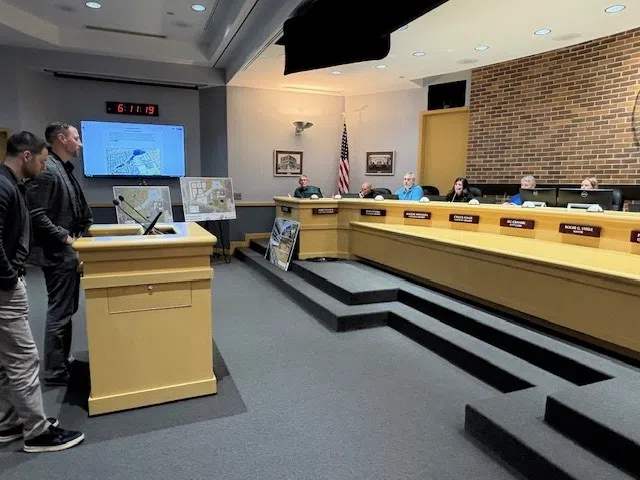
Mitch Hohlen (front left) and Drew Snyder of Woodsonia Real Estate in Elkhorn give a presentation at the Nov. 12 Grand Island City Council meeting about the executive summary for the Veteran's Village project through the Good Life District program. (Carol Bryant, Central Nebraska Today)
GRAND ISLAND – Drew Snyder, president of Woodsonia Real Estate, and Mitch Hohlen, director of development and a partner in the company, gave the presentation to the City Council at the Nov. 12 meeting about the company’s revised Good Life District Plan.
They showed slides of a 60-page executive summary about development of 225 acres of land known as Veteran’s Village. The property is located between Broadwell Avenue and Webb Road, and south of Airport Road/U.S. Highway 281, according to a memo from Regional Planning Director Chad Nabity. The estimated cost of the project is $600 million.
Major components of the plan are a Sports Complex and fields, Aquatic Center, expanded sports fields, expanded Eagle Scout Lake and trails, an amphitheater, a 10-acre space for an elementary school, commercial space for a hotel, event venue, restaurant, and planned mixed use space, apartments, and single family residential, according to a memo to the City Council from Chad Nabity.
Woodsonia’s first Good Life District application was approved June 5, 2024. Grand Island voters approved the Good Life District program on Aug. 13, 2024. The original Good Life District application was submitted Nov. 4, 2024. The state of Nebraska adopted a revised Good Life District amendment on June 4, 2025. Woodsonia submitted its revised Good Life District application on Aug. 15. The city did not release a copy of Woodsonia’s application after that date because of negotiations with the real estate company. Woodsonia will present a revised plan at the Dec. 9 City Council meeting. Mayor Roger Steele directed Woodsonia Real Estate to have the plan presented at the Dec. 9 meeting be a final version of the plan.
First, there would be a publicly owned Veteran’s Sports Complex with indoor and outdoor facilities. The indoor facility would cover approximately 100,000square feet and include 16 volleyball courts and eight basketball courts. Multipurpose courts would be available for pickleball, dance, cheer, gymnastics, wrestling, etc. There would be an area for concessions and meeting rooms.
The outdoor components of the Sports Complex would be artificial multisport fields, including four full-size baseball fields, four softball fields, six full-size soccer fields, 12 youth soccer fields, two full-size football fields, four lacrosse fields, and field training facilities. All existing grass fields would be relocated with accommodation for three full-size soccer fields and seven youth soccer fields.
The Aquatics Center would feature a three-land lap pool and an adjacent recreational pool that would include splash pad features for children, and a water slide. Consultants for the Aquatics Center are Brandstetter Carroll Inc. and HealthFitness. The Aquatics Center would have recreational play, aquatic fitness classes, group and private instructional swim lessons, age-group swimming lessons, lifeguard training, and rental of the facility. Regional Planning Director Chad Nabity said that the cost of the Aquatics Center would be $15 million.
The Aquatics Center and Fitness Center would be linked with a common locker room. The center would be staffed 105 hours per week. There would be 20.75 FTE employees. A general manager, operations manager, and marketing manager would oversee operation of the center. For the center, the number of “club-eligible households” would be 22,762. For the center, the five-year total revenue would be $15,948,958; and the five-year expense grand total would be $14,450,742. The net income over the five-year period would be $1,498,217. Ben Brandstetter works for Brandstetter Carroll Inc., which is a business with architects, engineers, and planners. He said that stand-alone aquatics centers are not very common.
There would be expansion of Eagle Scout Lake. First, the lake would be dredged to make it deeper. There would be a 20-acre lake expansion and two miles of walking trails. Public fishing piers and pedestrian bridges would be added.
The next feature is an amphitheater.
Commercial development is planned, with 72 acres of mixed-use with future hotels, restaurants, retail, commercial, and civic users.
Approximately 1,500 multi-family units and 291 single-family units of housing would be constructed.
The project would be organized in three phases. Phase 1 of the project would occur between 2026 and 2030. It would include development of mass site work/infrastructure, Eagle Scout Lake expansion, amphitheater, Aquatics Center, Sports Complex (indoor/outdoor), one hotel (Home2Suites), an event venue center/wedding venue for special events, one restaurant (District Eats), 250 multi-family housing units, and 20 single family housing units. Total project cost for Phase 1 is $142 million. This includes $95 million in Good Life bond proceeds.
Phase 2 would occur between 2030 and 2035, It would include construction of $20 million in mixed-use housing, 20 single family homes, and 250 multi-family homes. Phase 2 includes total project cost of $76 million, which includes $26 million in Good Life proceeds and $11 million in TIF financing.
Phase 3 would occur between 2035 and 2055. It would include $40 million in construction of mixed-use homes, 180 single-family homes, and 1,000 multi-family homes. Total project cost of Phase 3 would be $380,274,675. This would include $330,148,486 in private debt/equity, $41,126,189 in TIF financing, and $9 million in Good Life proceeds.
Development of an indoor/outdoor sports facility is outlined in the executive summary. Pinnacle Indoor Sports was retained by Woodsonia Real Estate to perform a market feasibility study about the sports facility. Norm Gill, president of Pinnacle Sports Group, said that Grand Island has an asset because it is centrally located. Potential users live within a one- to four-hour one-way drive from the location. Gill said that the indoor facility would cover 100,000 square feet. He described the facility as “tournament friendly.” Approximately 1,600 to 1,700 people could be inside the facility at any one time.
“The primary objective of this proposed development is to establish the facility as a premier sports destination,” the sports facility summary said. A primary purpose would be to attract tournaments for various sports.
“Developing a high-quality facility will establish Grand Island as a top destination for sports tourism, attracting non-local visitors and generating significant economic impact for the entire region,” the summary said.
Quality of life for Grand Island residents would be enhanced to creating a central sports and recreation hub.
Development of the sports facility could stimulate additional development, acting as a catalyst for new hotels, restaurants, and retail establishments.
There are five key factors indicating potential for a new indoor/outdoor sports facility. The report listed 12 locations with like-clients, none in Nebraska. Two of the 12 locations are corporate-based. They are:
*The proposed facility would establish a tournament destination in the area. Grand Island is located within a four-hour drive of a significant number of travel sports teams.
*The proposed facility would address unmet local needs.
*The proposed facility would create a year-round destination for sports programming, tournaments and events.
*The proposed facility would capitalize on strong community interest and partnerships.
*The proposed facility would leverage available land for development.
Pinnacle Sports Group made four assumptions concerning long-term financial sustainability. They are:
*Enough capital should be raised so debt service and cash flow during operational ramp-up are not undue burdens on financial performance.
*Minimize or eliminate applicable taxes for the facility to significantly enhance its financial sustainability.
*The number of hotel rooms in the Grand Island area will adequately accommodate the potential influx of overnight visitors.
*A team of professionals with experience in local programming should be established to oversee daily operations.
Pinnacle’s report has conclusions based on assumptions including:
*The number of similar sports facilities in the region will not differ significantly from what already exists in the area today.
*Sports participation will continue trending toward pre-pandemic levels.
*The economic data for the report is accurate as of the date of the report.
*Multiple partnerships with local sports groups, schools, and nonprofit organizations will be formed, as well as with tournament providers, to establish a mix of league play, tournaments and events, instructional classes, clinics and camps. A rental model alone will not be sufficient to cover capital and operational expenses for the facility.
The total revenue in the first four years of the project would be $123,556; $1,100,280; $1,249,530; and $1,500,180. The total expenses in the first four years of the project would be $213,752; $1,004,749; $1,039,558; and $1,089,147. Annual operating profit/loss in the first four years would be: -$265,643; $95,531; $209,972; and $411,033.
The report lists “open items to resolve. They include:
*Good Life funding for multi-family and single-family housing will be critical in Phase 1 and Phase 2 of the project.
*Single land conveyance of the sale area would occur on March 1, 2026, for $1. The city will retain ownership of the land encompassing Eagle Scout Lake, existing Veteran’s Village Sports Complex, expanded Veteran’s Village Sports Complex (indoor and outdoor components) and Aquatics Center land.
*The agreement has “land claw backs.” If Woodsonia Real Estate fails to deliver the Phase 1 components within 60 months of closing, Woodsonia Real Estate will convey any areas of the sale area which have not commenced construction back to the city for $1. If Woodsonia Real Estate does not complete at least $13.5 million in commercial/mixed-use development (beyond Phase 1) and an additional 250 multi-family and 20 single-family units by 2035, Woodsonia will forfeit all remaining Good Life District funds allocated for Phases 2 and 3, convey any remaining undeveloped land back to the city, and terminate any unactivated TIF project areas. Woodsonia Real Estate is relying on future TIF funding for the project’s success.
Next steps are formalizing a Good Life District development contract. This would formalize funding mechanisms, performance metrics, land conveyance and claw back provisions. The goal would be completion in 45 days. Second is completion of a TIF development contract. The goal would be completion in 45 days.