
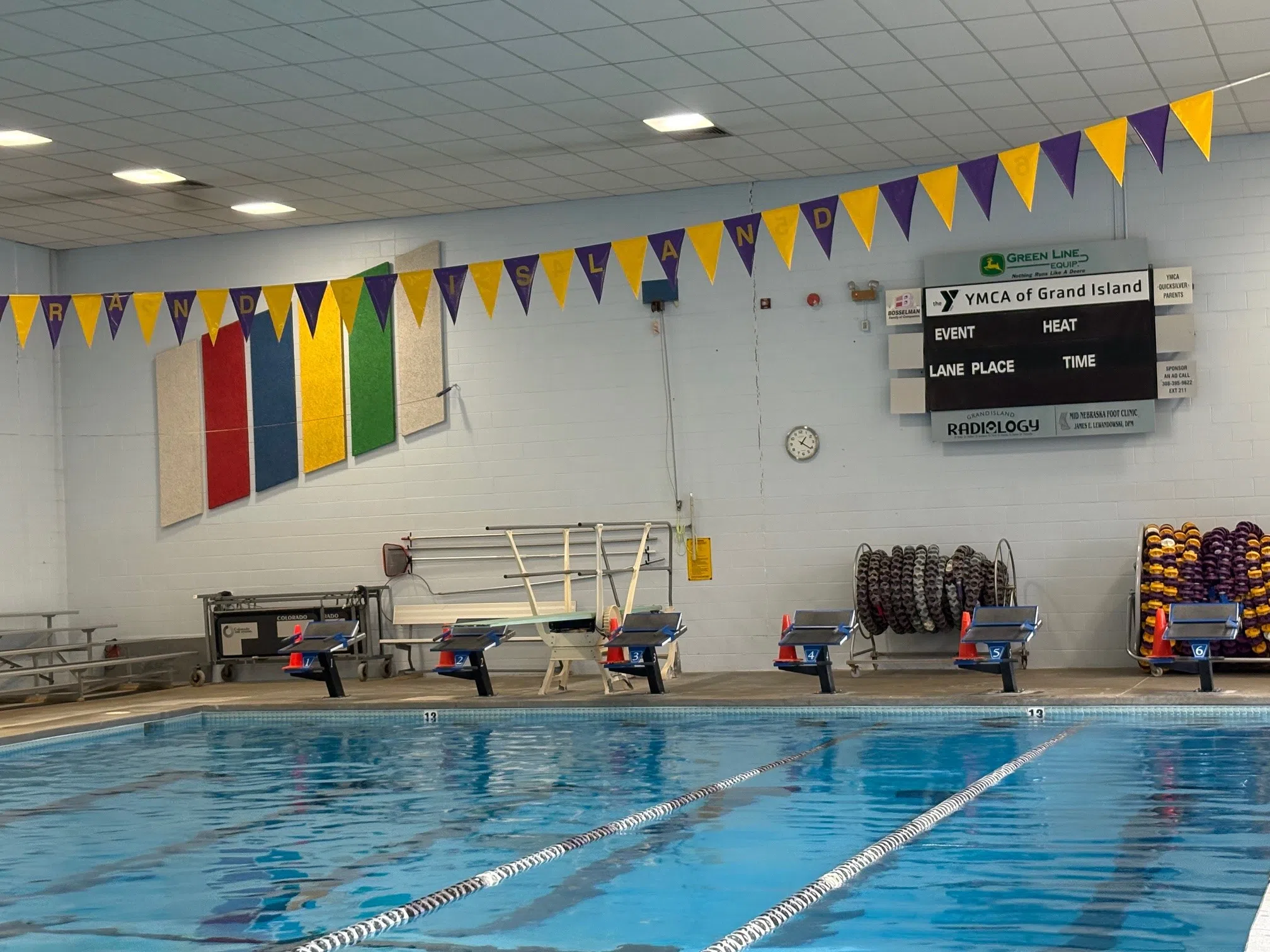
The YMCA's swimming pool has served the Grand Island area since 1979 and needs to be replaced. (Carol Bryant, Central Nebraska Today)
GRAND ISLAND – A swimming pool at a proposed Aquatics Complex funded by Good Life District funds should have eight to ten lanes, a Grand Island YMCA spokesman said. He also added that the YMCA is considering building a new facility adjacent to the site.
The description of the proposed Aquatics Complex presented at the Nov. 12 City Council meeting said that the swimming pool would have three lanes. The Grand Island YMCA opened in 1979 and has provided a swimming pool for the community for 46 years.
Pat O’Neill of Grand Island served on the YMCA’s board from 2019 to 2025. He is a spokesman for the YMCA regarding the proposed Aquatics Center and spoke at the Nov. 12 City Council meeting.
O’Neill said that the Aquatics Center should also have a diving board and a warm water therapy pool. He added that the Aquatics Center could possibly have a slide and a splash pad.
The proposed cost of the Aquatics Center and adjoining Fitness Center is $15 million, according to the executive summary for Woodsonia’s application. City Council members said on Nov. 12 that more money needed to be spent on the Aquatics Center. The estimated size for the Fitness and Aquatics Center and support amenities is 27,000 square feet.
“The best case scenario for the YMCA would be if the City and the developer would allow us to build a new, privately funded, YMCA next to the new aquatic center,” O’Neill said.
“The YMCA has extensive experience in managing both the aquatics and other youth programs, and this would be an excellent location closer to the City of Grand Island’s population center that would allow us to serve our core demographic while expanding into new markets. In addition to sports and adult fitness, the YMCA provides child care and multiple health and fitness classes for seniors,” O’Neill said.
“The Y has had several conversations with the past City Administrators and some conversations with the developer about building a YMCA at the Veteran’s Village. I think it would be a win-win for all involved. Woodsonia Real Estate has done great things with the Good Life District, and it looks like they will solve the pool issue that has faced the City of Grand Island for 30 years. The YMCA would be honored to be able to build on that and continue our service to the community,” O’Neill said.
The increased number of lanes is needed so that the pool can be the site for high school and YMCA Quicksilver swim team meets, for people who swim laps in the pool, and for swimming lessons. O’Neill said that the water temperature in a lap pool is approximately 77 degrees, while the water temperature in a warm water therapy pool is about 88 degrees.
“Our current pool is well past the end of its expected lifespan and has numerous issues. The pool concrete is in rough shape and the piping, pumps, filters and boilers are also needed to be replaced and or upgraded,” O’Neill said.
The YMCA has a six-lane, 25-meter pool. Other Nebraska pools are 25 yards long, O’Neill said.
“A new aquatics center would provide a place for city residents, swim teams, recreational swimmers and clubs to play, practice, and compete. Not only is aquatics a great recreational activity, but it is also a great rehabilitative option, and youth swim programs are growing rapidly. Swim lessons are vitally important in this area. With the prevalence of sandpits and other natural bodies of water, teaching kids to swim is an important and potentially life saving lesson,” O’Neill said.
“A warm water therapy pool is designed to be somewhat shallow and warmer than a standard pool. This makes the pool ideal for use by those with limited mobility, the elderly, and people undergoing physical rehab. It also works well for small children in beginning swim lessons,” O’Neill said.
He is currently on a committee to select the new YMCA CEO and is a liaison for aquatics. Prior to the YMCA Board, he was on the Quicksilver Swim Team board for three years.
He originally offered to join the YMCA board because of his involvement with the YMCA Swim Team.
“Once I saw all of the other issues facing the YMCA, we had to spend a few years getting that back on track and sustainable,” he said.
“Anyone involved in swimming or aquatics has known of the need for a new pool/aquatics center for decades,” O’Neill said.
“Grand Island has been historically underserved when it comes to indoor aquatics. What I learned after getting on the YMCA board is how many people outside of that community desire a new aquatic facility or YMCA. It apparently comes up a lot in business and employee recruitment. I have also learned that pools are usually built as a joint effort between YMCAs, cities, or school districts. Most new pools in Nebraska and South Dakota have been an effort between two or three of those entities,” O’Neill said.
In the mid-1990s, the YMCA Board formed an Aquatics Committee to look into constructing a new swimming pool in the community. At that time, the need for a warm water pool was expressed. The YMCA pool at that time was kept at a cooler temperature for competitive swimmers. The Aquatics Committee proposed construction of an Aquatics Center on the south side of Grand Island Senior High School, just south of the boys locker rooms.
The Aquatics Committee was not able to proceed with the project, because funding could not be acquired. At that time, it was suggested that the YMCA would need to establish an endowment for maintenance of the Aquatics Center, because Aquatics Centers may only break even financially.
After that, a Grand Island physician wrote letters to the editor of the Grand Island Independent, urging to community to construct a new Aquatics Center. Her children had competed on the Grand Island Senior High School swim team. Their family had previously lived in Arizona, and the quality of Aquatics Centers there exceeded the quality of the YMCA pool. The suggestion did not proceed because of lack of funding.
O’Neill said the YMCA received a cost estimate from Chief Construction of approximately $13 million for a new Aquatics Center.
“Adjusted for inflation it would be somewhere around $18 million to $20 million now,” O’Neill said.
He described the use of the YMCA pool.
“We see all age ranges and walks of life: lap swimmers in the morning, senior aqua aerobics mid morning, lap swim around noon, swim teams after school and evening and open swim at all times of day. We see a lot of kids under 18 and swimmers over 40,” O’Neill said.
O’Neill pointed out that the Good Life District program in Grand Island was initiated with Woodsonia Real Estate’s application to the state.
Mitch Roush, Director of Communications and Marketing for Grand Island Public Schools, said that Grand Island Senior High School, Northwest High School, and Grand Island Senior High School participate on the Grand Island Senior High School swim team. He said that there were 30 to 35 swimmers on the team last year, with the majority of athletes from Grand Island Senior High School.
The team has approximately 15 meets annually and does not have to limit the number of participants. The swim team season runs from the third week of November to the last week of February.
Included in Woodsonia’s Good Life District application was a sports facility demand assessment by Victus Advisors, a Utah sports consulting firm.
“Victus is of the opinion that a competitive aquatic center would not have the same economic impact potential as an indoor multi-use sports center,” the Victus Advisors study said.
“If an aquatic center were built to accommodate both recreational and competitive use, a significantly larger and more expensive aquatic center would have to be built to provide both competitive and recreational pool areas. In addition, it should be noted that a public swim facility could have limited local/recreational access during large, competitive, weekend meets that utilize the entire facility,” the study said.
Based on Victus’ research in competitive aquatic centers nationwide, these features are recommended (at a minimum) to host major swim meets: eight to 10 long-course lanes, convertible to up to 26 short course lanes; 50-meter by 25-yard pool dimensions, spectator seating capacity of at least 500 seats; and a small, shallow lesson pool that could be used for purposes including warm water therapy.
According to the Woodsonia application, “$15 million feels significantly under budget. The Confluence master plan envisioned an Indoor Aquatics and Community Center at approximately 250’ x 350’ (87,500 SF), including a diving well, seating for 300–500 spectators, and amenities comparable to today’s YMCA. For context, a smaller 38,900 SF facility recently built in Ames, Iowa, came in at $32 million. That comparison raises red flags about the adequacy of the proposed budget.”


