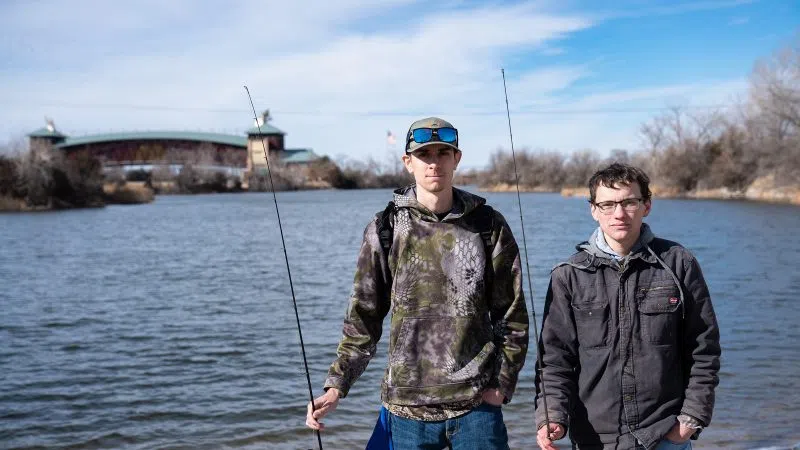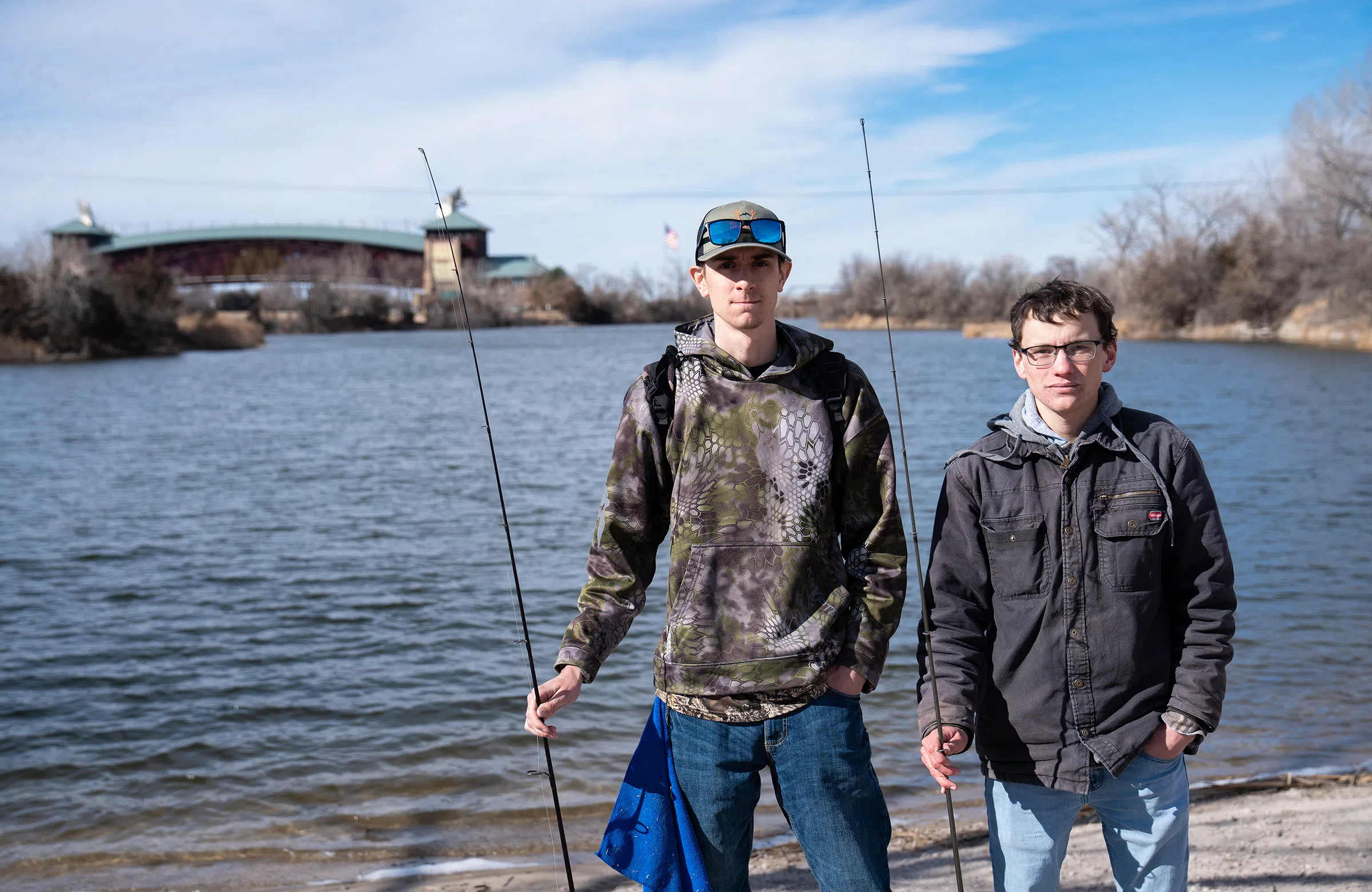
Pictured at Archway Lake in Kearney, Robert Allison, left, and Connor Banzhaf led the UNK team in the Hardwater Havoc collegiate fishing competition. (Photo by Roberto Bautista, UNK Communications)
KEARNEY – University of Nebraska at Kearney students reeled in a top-three finish during a North American collegiate fishing competition that wrapped up last week.
Graduate student Robert Allison of Middleton, Idaho, and junior Connor Banzhaf of Gothenburg led the UNK team during the six-week Hardwater Havoc, which blends ice and open water fishing with citizen science.
Competing against more than 30 colleges and universities in the U.S. and Canada, the pair helped UNK accumulate 668 total points to secure third place in the North Central Division. Both anglers also finished near the top of individual leaderboards.
Allison led the region with 353 total fish and 18 different species. Banzhaf, the team captain, was right behind him with 278 fish and 17 species. He landed the largest panfish, a 16-inch black crappie.
“I fish a lot,” said Banzhaf, a wildlife biology major. “I’m not much of a tournament person, but getting to represent UNK made me excited to get involved.”
Hardwater Havoc is a partnership between the American Fisheries Society and Angler’s Atlas, a Canadian company that provides tools and resources for anglers. Through its mobile app, MyCatch, anglers log catches that contribute to fisheries research and management across North America.
Participants were required to upload photos of each fish on a length board and record hook type and species information. In addition to competing for prizes, students could complete optional assignments to earn a micro-certification in applied citizen sciences for fisheries management.
UNK had eight students participate in the inaugural event.
Allison and Banzhaf focused much of their effort on waters in and around Kearney, including Yanney Park, Archway Lake and other public access areas along Interstate 80. They developed a strategy to balance team scoring opportunities with individual leaderboard challenges, including one task that required participants to catch fish with a homemade jig.
While much of their fishing was done independently, the two occasionally met up at local lakes.
“Connor and I are actually really good friends,” said Allison, who’s pursuing a master’s degree in biology. “We did some undergraduate research together, and we’ve had a little inner-team competition through Hardwater Havoc.”
Biology professor Melissa Wuellner encouraged the students to participate, noting the value of both the competition and the research component.
“Getting outside, even in the winter, is good for anyone’s health,” Wuellner said. “I think the competition brought a sense of purpose and belonging, whether that was fishing with their teammates or contributing information that can be used for another purpose, like learning a new skill or managing a fishery.”
The data collected, including locations, catch rates and species breakdowns, will be used by the American Fisheries Society and participating institutions for educational and management purposes.
For Allison and Banzhaf, the third-place finish proved something else, too.
“Most of our fishing was done right here in Kearney,” Banzhaf said. “This shows that you don’t have to travel long distances to chase a bite. Taking advantage of the opportunities in our own backyard to accomplish something like this is pretty cool.”