HASTINGS — Hastings officials provided details and lessons learned from an incident that included volatile chemicals in the sewer system and a brief residential flash fire that led to a manhole cover being blown from the road on Wednesday, Jan. 17.
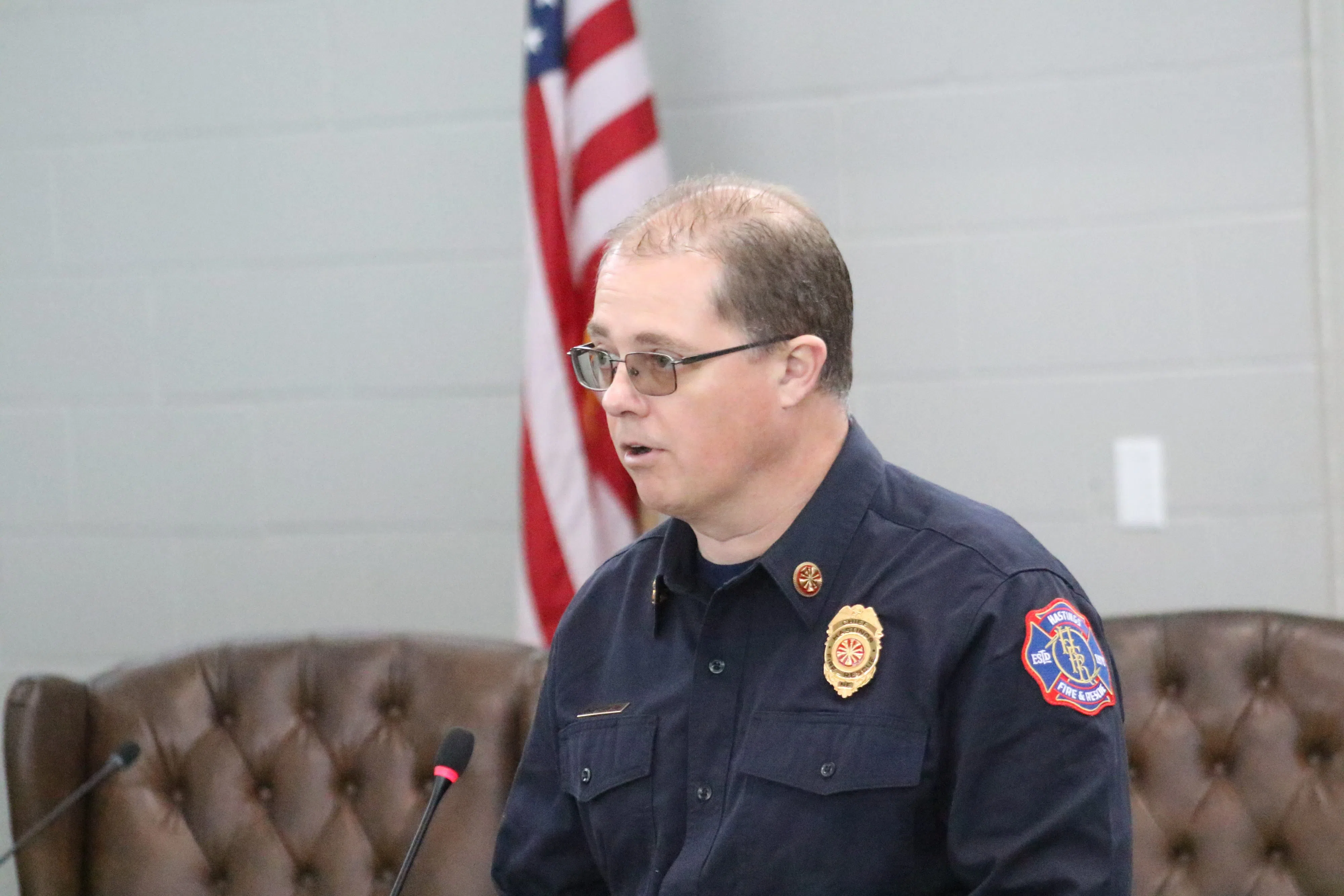
A press conference was held on Wednesday, Jan. 24 at the Hastings Municipal Airport that included details and comments from Brad Starling, Hastings Fire and Rescue Fire Chief; Brandan Lubken, Director of Underground Operations with Hastings Utilities and Chad Bunger, Director of Development Services.
Starling opened with details about what occurred on Jan. 17.
Around 3 p.m., Hastings Fire and Rescue was dispatched to the 400 block of South Woodland Avenue, on the southwest side of Hastings, for the report of a loud explosion and a manhole cover thrown from the roadway.

Brian Neben, Central Nebraska Today
The first units to arrive discovered the manhole cover laying in the street which had shattered when it landed after the explosion.
Firefighters began to investigate the cause of the explosion and discovered that several residents in the immediate area were complaining of gasoline or acetone smells in their homes and basements.
Crews used specialized equipment to check for volatile chemicals and ventilated the structures to remove any hazards involved. Some residents were evacuated during this period but were allowed to return when the threat was mitigated.
Due to a possible explosion in the sewer system, Hastings Utilities was notified, which sent wastewater crews to evaluate the condition of the sewer system and identify any sources of hazardous materials contamination, Starling said.
Lubken said sewer issues require immediate attention and can put city staff at risk. Damage can also occur with situations like this.

Brandan Lubken, Director of Underground Operations with Hastings Utilities, (Brian Neben, Central Nebraska Today)
A contractor who was able to move a camera through the sewer system found new cracks. “We are still investigating further but there appears to be damage,” Lubken said.
While he is awaiting the report from the contractor in writing, Lubken said there was no collapse of the system where the explosion occurred and can still be used.
Lubken noted the same contractor had been working in the area just two months ago, so Hastings Utilities has a good sense of what the system looked like before and after the incident.
Bunger added later the city is working under the assumption that the source of the chemicals was not from a private residence but that it could have been from a commercial source.

Chad Bunger, Director of Development Services, (Brian Neben, Central Nebraska Today)
“Its most likely a commercial or industrial source,” he said.
Continuing the investigation process, firefighters were alerted to a nearby residence, on the same block as the manhole cover, that suffered a dryer explosion.
The residents stated that, around the same time that the manhole cover was blown form the road, they heard a loud boom in their residence.
Starling said when the residents went to investigate, they discovered clothing in a basket that was on fire. They were able to extinguish the fire themselves.
“We believe the violate sewer vapors worked their way up through the sewer system and found an ignition source at the furnace of this home,” Starling said, “The laundry basket sat between the furnace the floor drain, putting it in an ideal position to absorb the toxic fumes, until the furnace was turned on.”
The ignition from the furnace caused a brief flash fire that over pressured the sewer system, and the resulting explosion is what caused the manhole cover to be blown from its place, said Starling.
Firefighters and utility crews were able to access the sewer system and found evidence of volatile chemicals within. The system was ventilated and flushed with water to remove the immediate hazard.
“We continue to work to find the source of contamination and have not yet found a direct source,” Starling said.
Lubken said while the volatile chemicals have not yet been positively identified, they were clearly combustible vapors. He added that residents smelling gasoline or acetone after the explosion gives some hints as to their origin.
“I want to stress, we were lucky,” said Starling, “In order for this explosion to happen, several circumstances had to come together.”
Violate chemicals had to be released into the sewer system, vapors from those chemicals had to collect at high enough levels to support an explosion and then the vapors had to work their way through the system to find a source of ignition.
Starling said there were no injuries as the result of the flash fire or sewer explosion.
“If we don’t address the contamination, we might not be so lucky next time,” Starling said, “This explosion could have easily caused significant property damage and loss of life.”
Starling said through prevention and education, Hastings Fire and Rescue hopes to prevent any similar incidents from occurring in the future. He stressed to the residents in the area that they continue to investigate the source of the hazardous materials in the sewer system.
Members of Hastings Fire and Rescue will be contacting residents to make sure they are aware of the hazard, to know what to look for, how to report hazards and what can or cannot be released into the sewer system.
Contact will also be made with those commercial and business properties whose sewer lines feed into the area of Woodland Ave. and A and B Streets.
“We want to make sure we are aware of the hazards within their facility, and they have all the required safety measures in place,” Starling said, “These are things we can control, we want to make sure it doesn’t happen again.”
Lubken said when hazardous substances are put into the sewer system it affects not only the community, but the utilities. He said volatile chemicals can track both up and down stream of the entry point.
In the Jan. 17 case, it is believed that the vapors travel uphill from the potential entry point.
Lubken said that if residents have questions about what can be put into the sewer system, to contact Hastings Utilities or the landfill first.
Bunger also spoke and added that better compliance with City of Hastings building permits, it can be ensured that infrastructure elements are in place that could help prevent situations like this from happening.