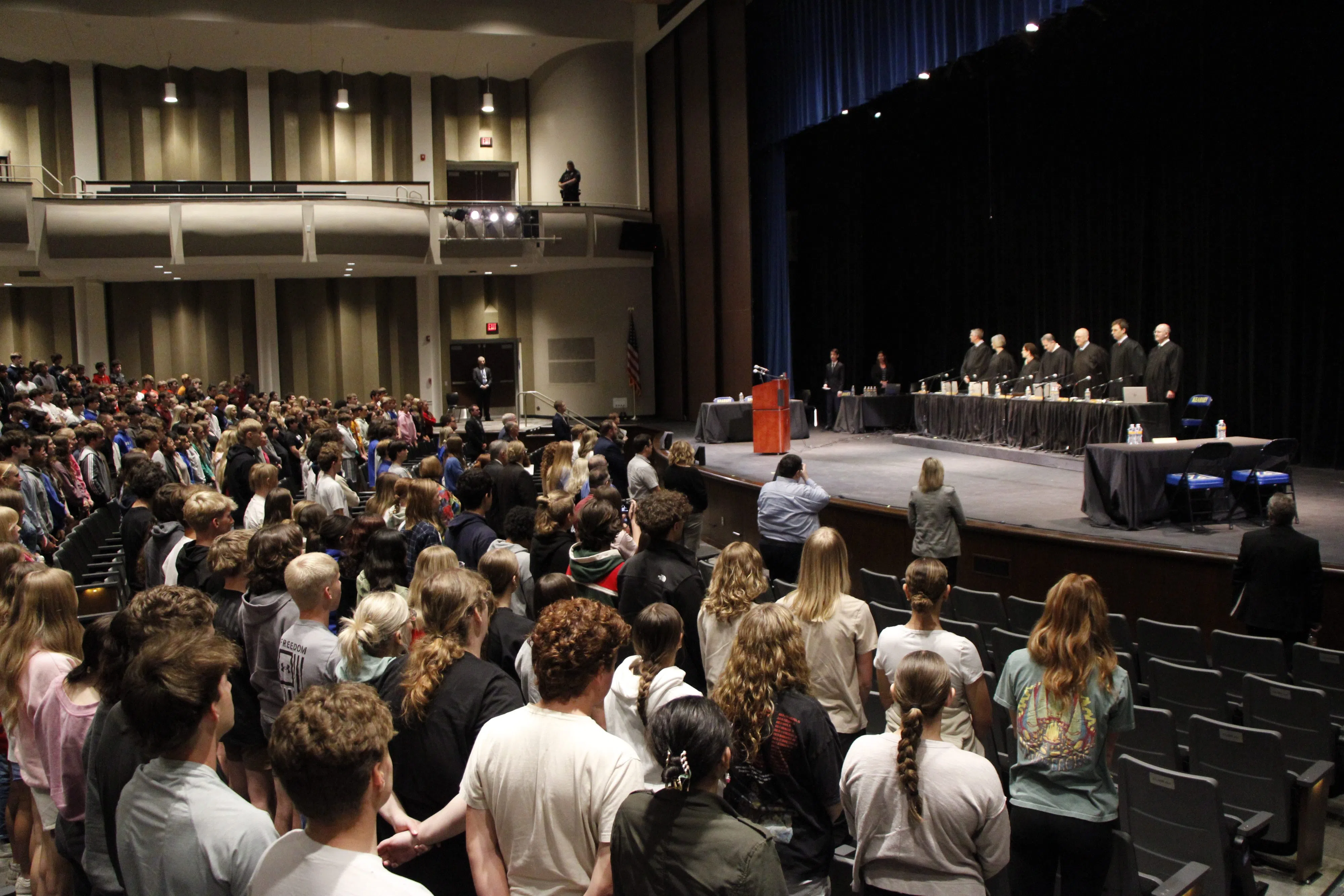
KEARNEY — Kearney High School students received look at the inner workings of the Nebraska Supreme Court during a special session that was held in Kearney on Tuesday, April 29.
“This marks the first time the state’s highest court will convene arguments at Kearney High, offering students a rare, firsthand look at the judicial process within the walls of their own school,” according to Kearney Public Schools (KPS).
The event is part of the Nebraska Supreme Court’s ongoing civics education and public outreach initiative, supported by the Nebraska State Bar Foundation, aimed at increasing awareness and understanding of the legal system among high school students.
The Nebraska State Patrol troopers who provided security during the event made it clear to the students that the auditorium would be considered a court room, with all the same rules in place when the justices began to hold their session.
Judge John Rademacher spoke to the students and help to explain the key differences between trial courts and appellate courts, helping students better understand the legal process before the court proceedings begin.
The context would prove important as the Supreme Court heard oral arguments in two different cases which included:
State of Nebraska v. John Parks, Sr., a criminal appeal from Douglas County
Estate of Paul A. Knapp, a civil appeal from Dodge County concerning a premarital agreement and family allowance dispute
“This event not only allows students to witness the judicial process in action, but also brings classroom civics lessons to life in a meaningful and memorable way,” said Principal Jeff Ganz. “We are honored to host the Nebraska Supreme Court and grateful for their commitment to student learning.”
The Supreme Court Justices include Hon. Jeffrey J. Funke, Chief Justice; Hon. Stephanie F. Stacy; Hon. Lindsey Miller-Lerman; Hon. William B. Cassel; Hon. Jonathan J. Papik; Hon. Jason M. Bergevin and Hon. John R. Freudenberg.
The court consists of a chief justice and six associate justices. The six justices each represent a Supreme Court district. If a position becomes vacant, the judicial nominating commission, made up of four lawyers and four non-lawyers, holds a hearing to select potential candidates.
The Supreme Court of Nebraska is separated into six districts, with one Justice selected for each. Each justice faces a retention election from his or her district except for the Chief Justice, who faces a statewide retention election.
District 1
District 1 consists of Lancaster County.
District 2
District 2 consists of Sarpy County and Cass County, Nebraska.
District 3
District 3 consists of Antelope, Boone, Boyd, Burt, Cedar, Cuming, Dakota, Dixon, Dodge, Holt, Knox, Madison, Pierce, Stanton, Thurston, Washington, Wayne, and Wheeler counties as well as parts of Douglas and Sarpy counties.
District 4
District 4 consists of Douglas County.
District 5
District 5 consists of Butler, Cass, Clay, Colfax, Fillmore, Gage, Hall, Hamilton, Jefferson, Johnson, Merrick, Nance, Nemaha, Nuckolls, Otoe, Pawnee, Platte, Polk, Richardson, Saline, Saunders, Seward, Thayer, Webster, and York counties.
District 6
District 6 consists of Adams, Arthur, Banner, Blaine, Box Butte, Brown, Buffalo, Chase, Cherry, Cheyenne, Custer, Dawes, Dawson, Deuel, Dundy, Franklin, Frontier, Furnas, Garden, Garfield, Greeley, Gosper, Grant, Harlan, Hayes, Hitchcock, Hooker, Howard, Kearney, Keith, Keya Paha, Kimball, Lincoln, Logan, Loup, McPherson, Morrill, Perkins, Phelps, Red Willow, Rock, Scotts Bluff, Sheridan, Sherman, Sioux, Thomas, and Valley counties.