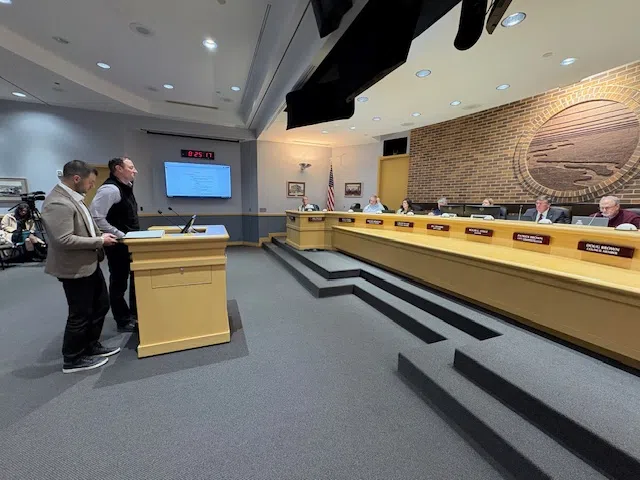
Mitch Hohlen (left), director of development and a partner with Woodsonia Real Estate; and Drew Snyder, president of Woodsonia Real Estate of Elkhorn, presented a revised Veteran's Village Good Life District plan at the Dec. 9 City Council meeting. (Carol Bryant, Central Nebraska Today)
GRAND ISLAND – The Grand Island City Council approved two resolutions Dec. 9 to pave the way for Woodsonia Real Estate to complete the Veteran’s Village project funded by Good Life District funds.
First, the City Council voted 8-1 to accept supplemental Good Life District application materials from Woodsonia Real Estate that are additional to the 550-page Good Life District application and 60-page executive summary that were included in the Nov. 12 City Council packet. City Council member Doug Lanfear voted against the motion. City Council member Mike Paulick was absent from the Dec. 9 meeting.
Second, the City Council authorized city staff to move forward with negotiating a development contract with Woodsonia Real Estate subject to the amended Good Life District application it submitted. The City Council approved the resolution by an 8-1 vote, with City Council member Maggie Mendoza voting against the motion.
Ryan O’Neill, who was elected City Council president Dec. 9, added an amendment to the second resolution.
The amendment said, “City Staff should incorporate the feedback, commitments, and concessions discussed at City Council on Dec. 9, 2025, into their negotiation authorities into a Development Contract and other legal documents and must take all efforts to negotiate terms and agreements that protect the City’s best interest and are consistent with the goals contained in the City’s Good Life District Economic Development Program as outlined in Grand Island City Code Chapter 38 Article II.”
“This amendment represents my desire to incorporate all of the commitments, concessions, and promises made tonight by Woodsonia Real Estate Inc and clarifies that City Staff has the authority to negotiate in a way so as to ensure that proposed terms that are inconsistent with our goals or the City’s best interest are not incorporated into final agreements, even if that is inconsistent with the various written application materials,” O’Neill said about why he suggested the amendment.
Numerous Grand Island residents and City Council members spoke during the 3.25-hour meeting, providing information and expressing concerns about the Good Life District project.
The main topics that speakers addressed were revised plans for the Aquatics Center, concerns about the scope of residential development in the project, and concerns about not including dedicated pickleball courts in the indoor Sports Complex.
The proposed development is located north of the Burlington Railroad tracks, south of Airport Road/U.S. Highway 281, and between Broadwell Avenue and Webb Road. It does not include the former Nebraska Veterans Home site. The estimated cost of the project is $600 million.
Major components of the plan are an indoor Sports Complex, Aquatics Center, expanded sports fields, expanded Eagle Scout Lake and trails, an amphitheater, a 10-acre space for an elementary school, commercial space for a hotel, event venue, restaurant, and planned mixed use space, apartments, and single family residential, according to a Nov. 12 memo to the City Council from Chad Nabity.
A major concern that City Council members expressed at the Nov. 12 meeting was only including a three-lane pool in the proposed Aquatics Center.
Drew Snyder, president of Woodsonia Real Estate, and Mitch Hohlen, director of development and partner in Woodsonia Real Estate, spoke at the Dec. 9 meeting. They mainly discussed a document titled “Proposed Terms” that contained information about their revisions to the Good Life District plan since the Nov. 12 City Council meeting.
The major change was expansion of the Aquatics Center to include a 10-lane, 25-yard competitive pool, compared to the previously proposed 3-lane pool. City Council President Ryan O’Neill said prior to the Dec. 9 meeting that the estimated cost of the Aquatics Center would be $25 million, which is $10 million more than the cost for the initial Aquatics Center. The Aquatics Center would cover approximately 30,000 square feet. O’Neill said that the YMCA pool has aged past its expected lifetime.
The Aquatics Center will also include a diving well to accommodate two diving boards, seating capacity for up to 400 people, a warm water therapy pool with zero entry, and a Jacuzzi. The lanes in the swimming pool can be configured north-south or east-west.
Chad Knight, the new director of the Grand Island YMCA who started in his job last week, said that the proposed Aquatics Center was a good plan to replace the YMCA’s pool, which opened in 1979. Pat O’Neill, who has been a spokesman for the YMCA, has said that the YMCA was interested in constructing a new YMCA at Veteran’s Village, adjacent to the Aquatics Center. Land is available for the YMCA to pursue that option.
Regional Planning Director Chad Nabity said that a first bond for the project would be issues in 2026, and a second bond would be issued in 2027.
Woodsonia staff said that the whole interest of the project is to bring more people to Grand Island.
Karen Johnson, president of the Grand Island Pickleball Club, expressed concerns about the plans for the indoor Sports Complex not including dedicated pickleball courts. Snyder said after the meeting that courts in the Sports Complex would include lines for pickleball courts, and that lines would be marked for 28 non-dedicated pickleball courts.
Johnson said that the Grand Island Pickleball Club was asking for the same considerations as development of dedicated pickleball courts in Kearney. She said that pickleball is the fastest growing sport in America.
“We should be the leader, not the follower,” Johnson said about development of dedicated pickleball courts.
She referred to a new sports center in Columbus that had eight dedicated pickleball courts.
It had been previously mentioned that there would be 32 non-dedicated pickleball courts at the Sports Complex. She said that number of courts would take up three to four football fields of space.
She said that tournaments for basketball and volleyball would take up weekend time at the Sports Complex.
Johnson said that no one from Woodsonia Real Estate has reached out to Grand Island pickleball players to discuss plans for pickleball courts at the Sports Complex.
Johnson said that a previous plan presented about the project showed that it would include dedicated pickleball courts.
Grand Island currently has non-dedicated indoor pickleball courts at the city’s Fieldhouse, Grand Island YMCA, and Grand Island Tennis Center. She said that indoor courts are not available for play at night and on weekends.
The Pickleball Club currently has 221 members who pay annual dues of $25 per person, Johnson said in an earlier interview. Johnson estimates that 1,500 to 2,000 people play pickleball in Grand Island, and the sport continues to boom in popularity for youth through senior citizens.
O’Neill commented Dec. 10 about not including dedicated pickleball courts in the Sports Complex.
“As buildings grow, long-term operating costs grow with them, and we’re trying to keep those costs as manageable for the City as possible while still expanding access for pickleball. This plan still provides more indoor access than they have now at the field house, and like similar complexes in Lincoln, we should be able to expand shared-court pickleball availability to far more time and space than is currently offered. It also gives us the ability to study the sport’s growing demand and understand what future expansion might be justified—whether that’s through a future YMCA project, a later fieldhouse phase, or another partner down the road,” O’Neill said.
Former Mayor Jay Vavricek said that he supported Woodsonia’s application. He referred to a saying that if a tree is planted, you may not get the chance to sit under it.
Grand Island developer Scott Rief, who leads his company called RIZER, wanted to thank Woodsonia Real Estate for its development of Conestoga Marketplace. He said that he supported the indoor Sports Complex at Veteran’s Village.
Rief said he was concerned about what he described as an “unfair advantage” being given to Woodhouse Real Estate for the amount of Good Life District funds and TIF financing for residential development. He also noted that Woodsonia Real Estate would acquire the Veteran’s Village property for $1 from the city.
Rief said that Woodsonia Real Estate would receive 23 percent of project funding from the Good Life District program and 10 percent through tax increment financing.
Rief referred to the number of multi-family and single family units that Woodsonia proposed. In Phase 1 of the project, 250 multi-family units and 20 single-family units would be constructed. In Phase 2 of the project (2030-2035), at least 20 single family units and at least 250 multi-family units would be constructed. In Phase 3 of the project (2036-2055), $40 million in mixed use development would occur. Construction would include 180 single-family homes and 1,000 multi-family units.
Rief, who has developed several apartment complexes in Grand Island, said that the city is starting to see a “softening market” with more apartment vacancies.
Rief said his company has 150 units open, and he is aware of other real estate developers with the same situation. Rief mentioned Talon Apartments, which has 208 units; Sterling Apartments, 222 units; Legacy 34, 303 units; and Oak Point with 154 units. The total number of units is about 887 units in the last 10 years.
City Council member Mitch Nickerson is a real estate agent. He was concerned about what he described as a very aggressive real estate project. Nickerson mentioned a Grand Island housing study that says that the city needs about 300 new housing units a year. The community is coming close to hitting that target, he said. Nickerson also pointed to a number of newly-constructed houses that have been vacant for a considerable amount of time.
City Council member Jack Sheard noted that Woodsonia is receive quite of bit of incentives for housing development.
Gerald Poels of Grand Island said he was concerned about the percentage of Grand Island that Woodsonia would “own for free.” He said that a feasibility study was needed to study items such as how many additional students would be attending Grand Island Public Schools. Costs for road maintenance and snow removal need to be considered.
“We don’t have those details,” Poels said.
He noted the amounts of money that the city would spend to develop a state park and to renovate Island Oasis.
Poels mentioned educational opportunities that are not available in Grand Island but are available in Kearney and Hastings. Kearney has a four-year university and an extensive campus for Central Community College. Hastings has a four-year college and a well-developed campus for Central Community College. Grand Island has no four-year college and has a smaller-sized campus for Central Community College.
Poels said that the community is going to need a new high school. He said that it made more sense to locate an indoor swimming pool at a new high school.
Drew Snyder said that Woodsonia had put a lot of effort into the Veteran’s Village proposal. He described the indoor Sports Complex as a “tournament driven sports complex.” Woodsonia would like to select the manager of the Sports Complex and Aquatics Center.
Mitch Hohlen with Woodsonia said that the company planned to build workforce housing. He said that there is a definiate demand for workforce housing. A reference was made to constructing a 1,000-square-foot home that would sell for $275,000. Hohlen said that a similar house elsewhere in the city might sell for $400,000.
Nickerson told Woodsonia staff that he hoped they had thought through their commitment for real estate development plans. He described their plan as “aggressive.”
Snyder said that housing would be phased in slowly for the project, and that developers wanted to succeed in the project.
Snyder described financing during phases of the project. In Phase 1A, anticipated net-to-project bond proceeds plus cash on hand would total $77,557,462. In Phase 1B, projected net-to-project bond proceeds plus cash on hand would total $17,651,246. The total of tax increment financing over a 15-year period is $52,126,189.
The city will explore levying a 200-basis-point occupation tax on sales occurring within the Veteran’s Village project area to be placed in a reserve fund and used for future maintenance and reserve expenses for the Sports Complex and Aquatics Center.
There are several proposed clawback conditions from Woodsonia concerning what happens if the company does not develop the project as stated. If Woodsonia does not deliver the Phase 1 infrastructure, Sports Complex, Eagle Scout Lake expansion, amphitheater, 250 multi-family units, 20 single-family units, a hotel, restaurant, and one additional commercial development within five years of closing, Woodsonia will transfer property that has not been involved in construction back to the city for $1.
If Woodsonia does not complete at least one commercial development, 250 multi-family units, and 20 single-family units by 2035, Woodsonia is proposing that it would forfeit all remaining Good Life District funds designated for Phase 2 and Phase 3 of the project, give any remaining undeveloped land back to the city, and cancel any unused TIF areas.
Woodsonia will not construct more than 100 multi-family units and 20 single-family homes on a cumulative annual basis, its proposal said.
Regional Planning Director Chad Nabity stressed proceeding with the project as soon as possible to show the Governor and Legislature that plans were moving forward and to avoid any future action that the Legislature could take about Good Life District funds.
Woodsonia wants to have “next stage documents” drafts by Jan. 23, 2026, and completion of draft documents related to issuance of bonds by Feb. 22, 2026.
Roger Bullington with Chief Construction said that the business had a good experience working with Woodsonia Real Estate on the Conestoga Marketplace project.
“It’s very hard to be a developer,” Bullington said.
Bullington said that the redevelopment of Conestoga Mall, which he described as a “zombie mall,” could serve as a case study in mall redevelopment. He noted that Target opened six months early, which means that more revenue was produced with the early opening.
Bullington said that Woodsonia’s plan for Veteran’s Village was the “proper way to do it.” He said that if there are “too many cooks in the kitchen” for project development, the desired results may not occur. Bullington said that “time is of the essence” in proceeding with the Veteran’s Village project.
City Council member Doug Brown said, “I think this is a golden opportunity for Grand Island.”
City Council member Jason Conley said that he would support the project.
Toward the end of the meeting, Mayor Roger Steele spoke about the Good Life District project.
“Maybe we’re just lucky,” Steele said.
He said that the community was lucky that Woodsonia Real Estate completed a plan to redevelop a “zombie” Conestoga Mall into Conestoga Marketplace, which includes a Target store. Steele said that Woodsonia stepped forward and submitted a 550-page Good Life District application.
Steele said that the Veteran’s Village project will provide residential, commercial, and recreational features. He said he was “very pleased” with the city’s “good luck” for the Veteran’s Village plan.
“It has been a two-year slaughter for them,” Steele said about the work that Woodsonia Real Estate has done in preparing the Veteran’s Village plan.
A timeline for the project is mentioned in the executive summary that Woodsonia Real Estate presented at the Nov. 12 City Council meeting. The City Council passed a resolution in December 2023 to support Woodsonia Real Estate’s Good Life District application to the state. The initial application was approved in June 2024. Grand Island voters approved of the project in August 2024. The state adopted an amendment to the Good Life District project in June 2025. Woodsonia submitted a revised Good Life District application in August 2025.
The public did not get information about Woodsonia’s plan until the presentation at the Nov. 12 City Council meeting. Former Mayor Jay Vavricek said at the Nov. 12 meeting that he was concerned about the lack of information provided to the public by media prior to the Nov. 12 meeting.